
Overview
The yellowjacket is the wasp most likely to sting an Ontario homeowner — not because it’s the biggest, but because it’s the one you never see coming. Unlike the grey paper nest of the bald-faced hornet hanging under an eave, a yellowjacket nest is usually underground in an old rodent burrow, or tucked inside a wall void, soffit, or hollow porch pillar. All you notice above ground is a steady stream of wasps disappearing into a single point. That hidden location, combined with an aggressive defence and the ability to sting repeatedly, is exactly why a mower, a footstep, or a weed-whipper near the nest can trigger a mass swarm. In a household that expects its yard to simply be safe, the ground nest is the one wasp problem that’s easy to miss and hard to forgive once someone gets stung.
Identification
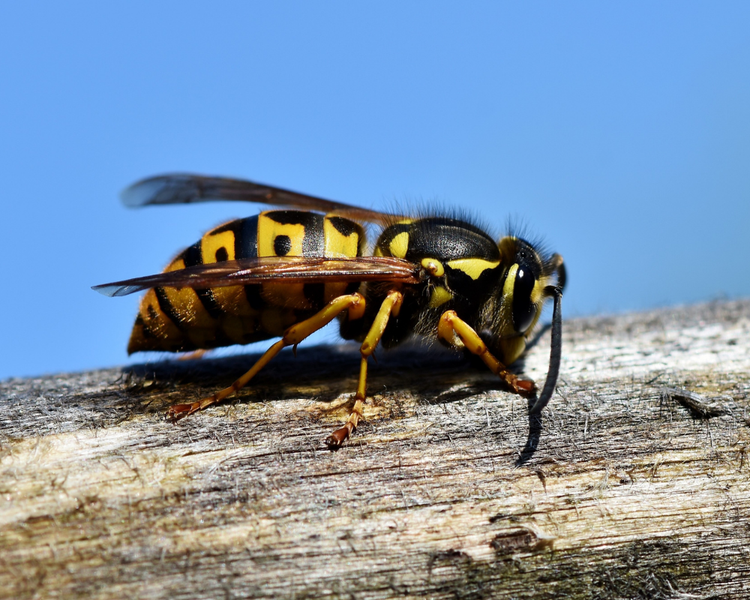
Yellowjackets are small, stout, and shiny — bright yellow and black, roughly 10 to 15 mm, and noticeably compact, tucking their legs in during flight. That build is the quickest way to separate them from the paper wasp, which is slender with long legs that dangle underneath as it flies. Colour alone won’t do it, so read the whole insect and, better yet, the nest.
| Feature | Yellowjacket | Paper Wasp |
|---|---|---|
| Body | Small, stout, compact | Slender, elongated |
| Legs in flight | Tucked in | Long, dangling |
| Colour | Bright, shiny yellow and black | Brownish with yellow markings |
| Nest | Enclosed; underground or in wall voids | Open umbrella comb, visible cells |
| Aggression | High — defends aggressively | Low to moderate unless disturbed |
The nest is the giveaway. A yellowjacket colony builds enclosed grey paper combs, but you rarely see them — the entrance is a hole in the turf or a gap in the siding with constant two-way traffic. If wasps repeatedly vanish into the same spot in the ground or wall, treat that point as an active nest.
Life Cycle
A single fertilized queen overwinters in a sheltered spot, emerges in spring, and founds the nest alone, choosing an underground cavity or void rather than an open branch. She raises the first batch of sterile female workers, who then take over foraging and construction while she shifts to full-time laying. Through summer the worker force compounds, and the colony reaches its largest size — up to roughly a thousand workers in a mature nest, and considerably more in some late-season colonies. Late in the season it produces new queens and males; the males die after mating, only the new queens overwinter, and after the first hard frost the workers and old queen die. The nest is never reused.
Habitat & Behaviour
Yellowjackets are bold, adaptable social wasps that readily choose underground cavities — abandoned rodent burrows, gaps under patio stones and retaining walls — as well as wall voids, attic insulation, and hollow structural spaces. They defend the nest against anything they perceive as a threat, and ground vibration is a classic trigger. Because the nest is concealed, the colony can grow to hundreds or thousands before a homeowner registers there’s a problem at all.
Diet
Early in the season, workers hunt insects and other protein to feed developing larvae, so they largely ignore your food. That changes in late summer: once the queen stops producing worker larvae, the sugary secretion the adults fed on disappears, and the workers redirect to sugar — fallen fruit, garbage, recycling, open drinks, and anything sweet on a patio table. This is why the yellowjacket that ignored you in July is landing on your plate in August — the biology behind late-summer wasp aggression explained.
Signs of Infestation
- Steady two-way traffic to a single point — a hole in the lawn, a gap in the siding, or a soffit seam — with no visible nest. This is the most reliable sign, covered in our ground-nesting yellowjacket alert.
- Low-flying wasps hovering just above the lawn or mulch along garden beds and retaining walls.
- A nickel-sized ground entrance with bare, worn turf around it.
- A sharp jump in stinging activity near one spot when you mow, weed, or trim.
- Scavenging around garbage, recycling, and food in late summer, well away from the nest.
Damage Caused
Yellowjackets don’t damage wood or wiring the way structural pests do, so the harm is indirect. The one exception worth flagging: a nest inside a wall void should never be sealed while active — trapped workers will chew through drywall and emerge inside the living space within days. That turns a contained outdoor problem into an indoor one, which is why a hidden nest is a professional job rather than a caulk-gun fix.
Health Risks
This is the serious part. Yellowjackets sting repeatedly, defend as a group, and nest where people don’t expect them — the combination that makes them the wasp most responsible for sting incidents. For most people a sting is painful but minor, but systemic allergic reactions affect an estimated 0.4% to 0.8% of children and around 3% of adults, and a person who has had a severe reaction faces a substantial risk of another. A nest nobody can see, in a spot the whole family walks across, is precisely the wrong place to discover an allergy. For commercial patios and dining areas, a scavenging colony in late summer is also a direct customer-safety risk. It’s the biggest reason we don’t recommend waiting a nest out when it’s near living space.
Seasonal Activity in Ontario
June is colony-founding season, when queens establish new ground nests that hold one queen and only 20 to 100 workers — the easiest, safest removal window of the year. Through July the colony enters fast growth, roughly doubling every two to three weeks in the summer heat. By August and September the nest is at peak size and peak aggression, with workers fighting over shrinking food. The fast-growth phase in late June is the moment to act. Across the GTA and Simcoe County, ground nests flare in suburban lawns — from Whitby and Oshawa in Durham to Vaughan and Barrie — while cottage-country properties near Orillia and Lake Simcoe can hide colonies for weeks between visits. A hard frost in October or November ends the colony.
Where They Hide
Underground in abandoned rodent burrows, under patio stones, and along the base of retaining walls and garden beds; inside wall voids, soffits, hollow porch pillars, and attic insulation; and occasionally in sheds and under low decking. The common thread is a concealed cavity with a small, defensible entrance.
How They Enter Homes
Yellowjackets exploit gaps around soffits, fascia, vents, and utility penetrations to reach wall voids and attics. A loose soffit screen, an unscreened gable vent, or a worn gap around a dryer vent is all a founding queen needs. Once inside a void, the only visible sign is traffic in and out of that single gap.
Prevention Tips
- Walk your yard before you mow. Scan lawn edges, garden beds, and the base of retaining walls for steady wasp traffic, and mark any active hole from a safe distance.
- Seal gaps around soffits, fascia, vents, and utility penetrations before nesting season, so a queen can’t reach a wall void.
- Screen openings — add mesh to attic and gable vents and tighten loose soffit screens.
- Keep garbage and recycling lidded and rinsed; sugary residue is a late-summer magnet.
- Cover food and sweet drinks outdoors and check open pop cans before drinking in August and September.
- Clear fallen fruit and cover compost, both strong late-season food sources.
- Inspect early each spring — a founding queen in May is a five-minute fix; a full colony in August is not.
DIY vs. Professional Treatment
A DIY attempt on a ground or wall nest means approaching a hidden colony at dusk, applying product into a cavity you can’t fully see, and hoping you judged the size right — with no easy retreat if the swarm comes up out of the turf. The trade is a few dollars of store spray and real personal risk versus a scheduled visit that ends the colony without you standing over it. A licensed technician treats the nest entrance directly, so the product reaches the queen and brood and eliminates returning foragers, and leaves a concealed entry open until the colony is dead before anything gets sealed — the process is detailed in our field report on what happens during professional wasp nest removal. Sani IQ backs every wasp job with the Pest-Free-Or-It’s-Free guarantee, and season-long coverage is available through our residential pest control plans; see plans and pricing for current rates. For most households with kids or pets using the yard, the math favours a professional — see our honest breakdown of DIY versus professional wasp removal.
References
- Health Canada — Wasps
- University of Maryland Extension — Social Wasps: Yellowjackets, Hornets, and Paper Wasps
- University of Minnesota Extension — Wasps and Bees
Last updated: July 16, 2026 · Reviewed by Sani IQ licensed technicians