
Overview
Paper wasps are the most common stinging insect Ontario homeowners deal with, and usually the easiest to identify — their nests are open-faced, so you can see the individual honeycomb cells hanging under a horizontal surface. If you’ve spotted a few wasps circling the same corner of your porch or coming and going from under the deck railing, you’re seeing the start of a paper wasp colony, not a passing visitor. In June that nest is the size of a golf ball, tended by a single queen and a handful of workers. Left alone, it grows into a colony of dozens through the summer, and the wasps grow more protective as it does. Paper wasps are the least aggressive of Ontario’s social wasps, but “least aggressive” is not “harmless” — a nest within reach of a doorway, patio, or deck is still one to handle.
Identification
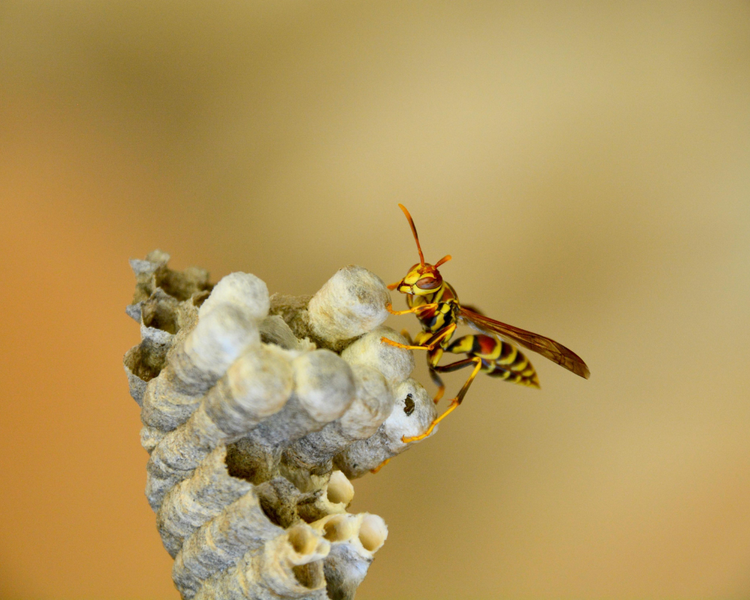
A paper wasp is slender and elongated, roughly 16 to 20 mm, brownish with yellow markings, and — the key tell — it lets its long legs dangle beneath its body in flight. That gives it a very different silhouette from a stout, compact yellowjacket that tucks its legs in. The nest is even more diagnostic than the insect.
| Feature | Paper Wasp | Yellowjacket |
|---|---|---|
| Body | Slender, elongated | Small, stout, compact |
| Legs in flight | Long, dangling | Tucked in |
| Nest | Open umbrella comb, cells visible | Enclosed; underground or in walls |
| Nest location | Under eaves, railings, door frames | Ground holes, wall voids, sheds |
| Aggression | Low to moderate | High |
The open, umbrella-shaped comb — visible hexagonal cells with no outer covering, hanging from a single stalk — is the surest identifier. Bald-faced hornets, by contrast, wrap their comb in a fully enclosed grey paper envelope, and our wasp and hornet nest identification guide shows the three side by side.
Life Cycle
Paper wasps overwinter as fertilized queens, then emerge in spring to start new nests. Through late April and May the queen works alone, chewing wood into paper pulp and building a small open comb. By June the nest is established but still small, and the first workers emerge to take over foraging while the queen shifts to laying. The colony grows steadily through July and August, reaching its maximum size — commonly 20 to 30 adults — between July and September. New queens and males are produced late in the season; only the mated queens overwinter, and the nest is abandoned after frost, never to be reused.
Habitat & Behaviour
Paper wasps favour sheltered, rain-protected surfaces: under deck boards and railings, beneath eaves and soffits, inside open garages and sheds, and around door and window frames. Anywhere a small umbrella nest can hang out of the weather is fair game, which is why mature backyards with decks, pergolas, and fences offer endless sites. Their focus early in the season is building and provisioning, so they’re relatively indifferent to people — but that changes as the colony grows and there is more brood to defend.
Diet
Paper wasps are useful predators for much of the season, hunting caterpillars and other soft-bodied insects to feed their larvae. The adults themselves take nectar and sugars, and like other social wasps they turn increasingly to sweet, human food sources in late summer as natural food thins and the colony’s internal sugar supply runs down. That late-season shift — the same one that drives wasp aggression in late summer — is what brings them to patios, garbage, and open drinks.
Signs of Infestation
- A small open umbrella-shaped comb with visible cells, hanging from a stalk under an eave, railing, or deck board. This is the clearest sign.
- Wasps repeatedly flying to and from one sheltered spot — a nest entrance, not a stray.
- Nests around door and window frames, especially on shaded north- and east-facing sides.
- Activity in open sheds and garages, on ceilings and rafters.
- More wasps near patios, garbage, and food as the season progresses into late summer.
Damage Caused
Paper wasps cause no structural damage — they don’t bore wood or chew wiring, and the paper comb is a seasonal, lightweight structure. The practical concern is entirely about location and sting risk: a nest over a patio, doorway, or play area is a hazard to people, not to the building. For homes and businesses alike, the “damage” is really the liability of a nest where people pass.
Health Risks
Paper wasps can sting repeatedly, and disturbing even a small nest can provoke the whole colony at once. For most people a sting is painful but minor; the real risk is for anyone with a venom allergy, for whom a sting can be a medical emergency — one reason a nest near living space is worth removing rather than leaving. Because paper wasps favour doorways, porches, and deck rails — high-traffic spots — the odds of an accidental encounter are higher than the insect’s mild temperament suggests. For restaurants, hotels, and retail patios, a nest over an entrance or dining area is a customer-safety and reputation risk that a scheduled exterior inspection catches while it’s still small.
Seasonal Activity in Ontario
Queens emerge and build starter nests from late April through May. By mid-to-late June those nests are golf-ball-sized and least defensive — the easiest, safest window to remove one. The colony grows through July and August, doubling roughly every two to three weeks in the summer heat, and reaches peak size and aggression in late summer. Across the GTA — from Mississauga decks to Oakville pergolas and Etobicoke porches — June call volume climbs every year as the first nests appear. A hard frost in October or November ends the colony.
Where They Hide
Under deck railings and the underside of deck boards, beneath eaves, soffits, and porch ceilings, around door and window frames, inside open garages and sheds on ceilings and rafters, and under pergola beams. The preference is always for a sheltered horizontal surface with overhead cover from the rain.
How They Enter Homes
Paper wasps generally nest on exterior sheltered surfaces rather than penetrating the building envelope, so they less often end up inside walls than yellowjackets do. Occasional indoor sightings happen when a nest is built in an open garage, shed, or attic accessible through a gap, or when a fall-season queen seeks an overwintering spot. Sealing gaps around soffits and vents removes the interior options.
Prevention Tips
- Walk the property monthly from May through August, checking eaves, railings, pergola beams, and shed rafters for small umbrella nests.
- Watch for a wasp flying repeatedly to one spot — that’s a nest entrance; note the location and rough height.
- Seal gaps around soffits, vents, and door and window frames where wasps shelter.
- Keep garbage and recycling closed and rinsed, and cover food and drinks outdoors in late summer.
- Store BBQ covers, planters, and toys where they’re not left undisturbed for weeks — favourite hidden nest sites.
- Deal with a small nest early — a June nest is a quick job; the same nest in August is a defensive colony.
DIY vs. Professional Treatment
A small, fully exposed paper-wasp nest you can reach standing on the ground is the one wasp job careful DIY can handle early in the season. Be honest about the trade, though: you’d be buying spray, choosing a moment when wasps are least active, treating from directly beneath the nest, and then monitoring for a rebuild — all while accepting the chance of multiple stings if anyone in the household reacts badly to venom. Knocking a nest down with a broom often just scatters survivors that rebuild a few feet away. For anything above head height, larger than a golf ball, or near an allergic family member, professional removal takes the risk off your plate and confirms the nest is gone, backed by Sani IQ’s Pest-Free-Or-It’s-Free guarantee. Properties that see wasps every summer often move to a season-long residential pest control plan; you can review plans and pricing up front. Our DIY-versus-pro breakdown lays out the full decision.
References
- Health Canada — Wasps
- University of Maryland Extension — Social Wasps: Yellowjackets, Hornets, and Paper Wasps
- University of Minnesota Extension — Wasps and Bees
Last updated: July 16, 2026 · Reviewed by Sani IQ licensed technicians