
Overview
Mosquitoes are the number-one reason Ontario families abandon their decks in June and July — and in this province they carry more than an itch. West Nile virus is active in Ontario for 2026, spread by the Culex mosquitoes that breed in stagnant water across the GTA and Simcoe County. Only females bite; they need a blood meal to produce eggs, and they find you by the carbon dioxide and body heat you give off. The frustrating truth for homeowners is that most backyard mosquito misery traces back to a few fixable causes on your own property and a steady drift of adults from neighbouring yards, ravines, and ditches. That combination is exactly what a layered approach — source reduction plus a treated perimeter — is built to solve. Our mosquito control service targets both halves of the problem.
Identification
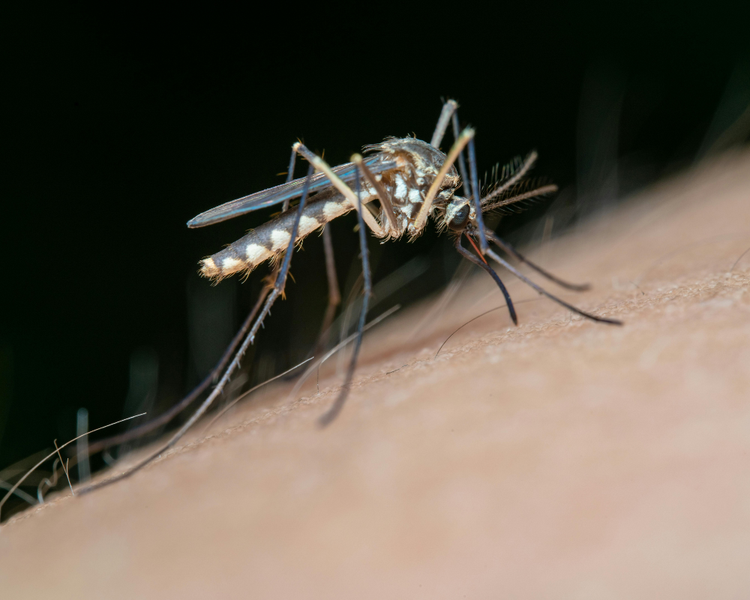
Ontario mosquitoes are small, 3–6 mm, brown to grey, with long legs, a single pair of narrow wings, and a prominent needle-like proboscis. Culex species — the main West Nile carriers — are dull brown and most active at dusk and after dark; Aedes species are often darker with banded legs and bite aggressively in daytime shade. The insects most often mistaken for mosquitoes are crane flies, the large, gangly “giant mosquitoes” that alarm homeowners but do not bite at all.
| Feature | Mosquito | Crane Fly | Non-biting Midge |
|---|---|---|---|
| Size | 3–6 mm | 15–25 mm (much larger) | 2–5 mm |
| Proboscis | Long, needle-like; bites | None; cannot bite | None; cannot bite |
| Behaviour | Whines, lands to feed | Clumsy, bumbling flight | Swarms in clouds at dusk |
| Threat | Bites; can carry West Nile | Harmless | Harmless nuisance |
If it whines near your ear at dusk and leaves an itchy welt, it is a mosquito; the leggy giant on your window screen is almost certainly a harmless crane fly.
Life Cycle
Mosquitoes complete a four-stage life cycle — egg, larva, pupa, adult — entirely in and around standing water. In ideal Ontario summer temperatures of 22–27°C, the whole cycle can finish in as little as seven days, which is why a warm, wet stretch can turn a bearable yard into an unusable one within a week. Females lay eggs on or near still water; larvae (“wrigglers”) and pupae (“tumblers”) develop in the water; and the emerging adults mate, with females seeking blood to fuel the next batch of eggs. Faster cycles mean populations compound before most homeowners notice the problem — the reason draining water promptly after a storm matters so much.
Habitat & Behaviour
Adult mosquitoes spend the heat of the day resting in cool, humid, shaded spots — the undersides of leaves, dense shrubs, fence lines, tall grass, and under-deck zones — then hunt at dawn and dusk. They are weak fliers, which is why a patio fan genuinely disrupts their approach and scatters your CO₂ trail. Properties near standing water, storm-water ponds, ravines, or dense shade carry the highest pressure, and much of the GTA fits that description. Established neighbourhoods with mature trees and low-lying, ravine-backed yards are classic hotspots where pressure jumps quickly after rain — a pattern we see across Etobicoke and Barrie lakeside lots alike.
Diet
Only female mosquitoes bite; both sexes feed on flower nectar and plant juices for energy. The female’s blood meal is strictly reproductive — she needs the protein to develop eggs. Some people genuinely get bitten more than others, driven by carbon dioxide output, body heat, skin chemistry, and blood type; our guide on why mosquitoes bite some people more explains what you can and cannot change.
Signs of Infestation
- Persistent biting at dawn and dusk in your own yard, not just near water.
- Wrigglers in standing water — tiny larvae jerking in birdbaths, buckets, clogged gutters, or rain barrels.
- Clouds of adults rising from shrubs, tall grass, or under-deck shade when disturbed.
- A yard that becomes unusable within days of a warm, wet stretch — the signature of a fast breeding cycle nearby.
Damage Caused
Mosquitoes do not damage buildings or belongings. Their cost is the loss of the outdoor space you pay for — the deck you cannot sit on after 7 p.m., the barbecue cut short, the evening driven indoors. For properties where the backyard is meant to be usable all summer, that is not a minor nuisance; it is a solvable problem being left unsolved.
Health Risks
The honest picture: most mosquito bites in Ontario are just itchy, but the public-health concern is real. West Nile virus is the most widely distributed mosquito-borne disease in North America, and most infected people have no symptoms or only mild ones — which means residents cannot rely on “feeling fine” as proof their yard is low-risk. A small percentage develop serious neurological illness, and that risk rises with age and weakened immunity. As one regional benchmark, the Durham Region Health Department reported 21 human West Nile cases and 26 positive mosquito batches in 2025 alone. Reducing bites is the single most effective protection.
Seasonal Activity in Ontario
Mosquito season runs May through October, peaking in the hot, humid stretch of late June through August. Health units set traps weekly from roughly mid-June to mid-September and test batches for West Nile; dead corvids — crows, ravens, and blue jays — are an early-warning signal because the virus often shows up in birds first. Positive mosquito pools typically first appear in mid-July, and human-transmission risk peaks late July into September. A cool, wet spring that leaves water lingering, followed by warm weather, sets up a heavy season — which is why gap-free control from late spring matters more than any single treatment.
Where They Hide
Larvae hide in any standing water: plant saucers, buckets, kids’ toys, wheelbarrows, tarps, pool and boat covers, clogged eavestroughs, rain barrels, ornamental ponds, tire swings, and low spots that puddle. Adults hide during the day in the shaded, humid resting zones a homeowner rarely thinks to treat — dense foliage, fence lines, under decks, and long grass. Cutting the breeding sites you control and treating the resting zones you cannot is the whole game.
How They Enter Homes
Mosquitoes are outdoor pests that slip indoors through torn or ill-fitting window and door screens, propped doors, and gaps around vents. They do not breed indoors in any meaningful numbers, so the fix is exclusion: tight-fitting, intact screens and sealed gaps. The bigger battle is always outdoors, where the population is actually made.
Prevention Tips
- Walk your property weekly and empty everything holding water — saucers, buckets, toys, tarps, wheelbarrows, old tires. A bottle cap is enough to breed mosquitoes.
- Refresh birdbaths and pet bowls every two to three days, before larvae mature.
- Clear clogged eavestroughs and check that downspouts drain away rather than pooling.
- Treat water you cannot drain — drop a BTI “mosquito dunk” in ponds and rain barrels; the naturally occurring bacterium kills larvae while sparing birds, bees, pets, and fish.
- Cut back dense, shaded foliage and keep grass short to remove adult resting sites.
- Run a patio fan where you sit — moving air is one of the simplest chemical-free deterrents.
- Seal and repair screens on windows and doors.
Our backyard mosquito guide covers the full checklist, and our myth-busting breakdown explains why gadgets fail.
DIY vs. Professional Treatment
Source reduction is DIY work everyone should do — draining standing water genuinely lowers how many mosquitoes hatch on your lot. Its limit is honest: it does nothing about the adults flying in from neighbouring yards, ditches, and ravines to rest in your shrubs. That gap is what a professional barrier treatment closes, coating the shaded resting zones where adults wait out the day. One treatment holds about three to four weeks, so a bite-free summer takes a planned series roughly every 21 to 28 days rather than a single spray. Because mosquitoes and ticks share the same shaded, humid yard zones, the two are often treated together in a single visit.
The trade-off is time, not just money: DIY means a weekly property walk and constant re-application of store products that protect for hours, while a scheduled program hands the cadence to a licensed technician. Sani IQ pairs targeted barrier treatment with a standing-water inspection and backs the work with our Pest-Free-Or-It’s-Free guarantee. For real numbers, see how long control lasts and the 2026 cost guide, or read the current West Nile alert. Book a free quote, take our free quote quiz, or compare plans and pricing.
References
- Public Health Ontario — West Nile Virus
- Government of Ontario — West Nile virus
- Government of Canada — West Nile virus
Last updated: July 16, 2026 · Reviewed by Sani IQ licensed technicians