
Do Wasps Come Back to the Same Nest? What to Do With the One You Just Found
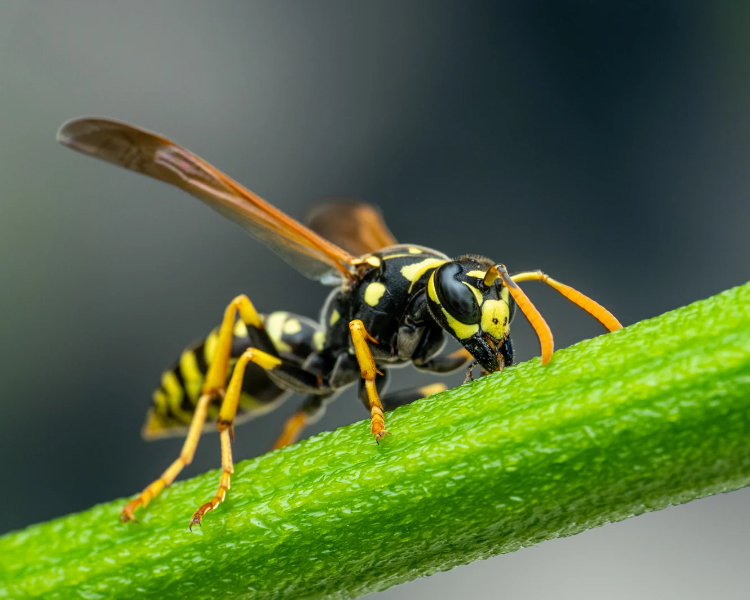
Quick answer: No. Wasps never reuse last year’s nest. The colony inside it died with the first hard frosts, and next spring’s queens build from scratch somewhere else. But the location gets reused constantly, because whatever made that eave, soffit or wall void attractive to a queen has not changed. The nest is old news. The gap it was anchored to is the thing worth dealing with — and November through March is the only stretch of the year when you can deal with it without a live colony in the way.
Why you are only noticing it now
Almost nobody finds a wasp nest in July. They find it in November.
The reason is simple and it is the same across Vaughan, Markham, Richmond Hill and every other part of our service area: the leaves come down. A grey, papery nest the size of a football can sit in a maple or against a second-storey gable all summer, fully screened by foliage, and then become the most obvious thing on the property in the space of about two weeks in late October. The nest did not appear. The cover did.
The same thing happens at ground level once the garden dies back. Nests tucked behind a cedar hedge, under a deck rim, or in the corner where a garage roof meets the house wall are suddenly in plain view from the driveway.
So the November call is predictable, and it arrives in the same form every year: there is an enormous nest on my house, how did I not see this, and what do I do? Our Vaughan pest control page covers the local picture — but the honest answer starts with some reassurance.
The colony inside it is already dead
Social wasps in Ontario — yellowjackets, bald-faced hornets, paper wasps — do not run a nest the way honey bees run a hive. Iowa State University Extension puts it plainly: a colony of social wasps “lasts only 1 year.” It is built in spring, peaks in late summer, and ends.
What ends it is the cold. In autumn the colony produces new queens and males, and as Iowa State describes it, “these leave the nest to mate, and the fertilized queens hibernate. The remainder of the workers, the old queen, and the males die of old age or freezing temperatures.” The founding queen who started the whole thing in April does not survive the winter either. Only the newly mated queens do, and NC State Extension notes that they do it alone and away from the nest — sheltering “under tree bark, in old stumps, or sometimes attics.”
That last location is worth filing away, and we will come back to it.
By the time a southern Ontario property has taken several nights of genuine hard frost, the nest you are looking at is an empty paper shell. Not dormant. Not sleeping. Empty.
No, they will not come back to it
This is the part that surprises people, and it is well established.
NC State Extension: “The current year’s nests are not reused the following spring.”
Iowa State Extension: “Each nest is built from scratch each year and the previous year’s nest can not be reused.”
There is no colony waiting inside to wake up in April. There is no queen hibernating in the middle of it. Next spring’s queens will chew wood fibre, mix it with saliva, and start a brand-new nest from a single cell.
Which leads somewhere counterintuitive: taking the nest down, by itself, prevents nothing. It is tidier. On a front elevation it is a great deal tidier. But if the only thing you do this winter is remove the shell, you have changed the appearance of the problem and not the problem.
What does get reused is the address
A queen coming out of hibernation in April is shopping for a very specific set of conditions: sheltered from wind and rain, dry, stable in temperature, and — for the cavity nesters — a protected void with a small, defensible opening.
Those conditions are a property feature, not an accident. They do not change over one winter. Which is why some houses get a nest in the same six-foot stretch of soffit three years running, while the identical house next door never gets one.
The repeat offenders we find over and over in GTA and Simcoe County housing stock:
- Soffit returns and the void behind vinyl soffit panels. A panel pulled loose at the corner, or a return never properly closed where the roofline steps, gives a queen a sheltered cavity with a slot-shaped door.
- Gable and roof vents with failed or missing screening. Common on anything built in the subdivision booms, and almost never checked.
- The junction where a garage roof meets the house wall. A deep, sheltered, south-facing corner. Nest magnet.
- Deck rims, porch ceilings and the underside of balconies.
- Gaps at the brick weep course and around hose bibs, gas lines and AC line sets — the same penetrations that matter for rodents, which is why one careful exterior inspection answers several questions at once. That overlap is the logic behind how we structure a residential pest control visit.
Fix the shell and you have done housekeeping. Close the cavity properly and you have taken the address off the market.
The nest you can see, and the nest you cannot
The big grey football hanging in the open is usually a bald-faced hornet nest — the species whose nest architecture most people picture when they hear the word, and worth knowing on sight if you want to tell it from the small open-celled paper wasp nest under a railing. Our bald-faced hornet page in the pest library covers identification.
Those aerial nests are the easy case, because you can see the whole thing.
The harder case is structural. NC State notes that bald-faced hornets will occasionally build “under roof overhangs, in attics, crawlspaces and wall voids, or under decks or porches,” and for a nest in a void or other inaccessible area they advise considering a pest control company rather than a DIY attempt. Yellowjackets do it more often.
If that is your situation, there is a specific reason not to forget about it over the winter. NC State’s guidance on a nest inside a wall is that after treatment it “may be desireable to remove it if convenient after spraying to avoid attracting carpet beetles.” A dead nest in a void is a large quantity of dead insect and larval material — food for scavenger insects. The wasp problem quietly becomes a different pest problem, plus occasional odour and staining where the void sits against a finished ceiling.
Should you take it down yourself?
Sometimes, yes. Three situations where you should not.
An exposed aerial nest, after a proper freeze, at a height you can reach from the ground. This is paper. Genuinely low risk, and you do not need to pay anyone. Bag it and bin it.
Now the exceptions.
Anything needing a ladder at height. The nest is harmless; the ladder is not. Falls do far more damage than wasps in November.
Anything in a void. Once the nest is inside a soffit, wall, vent or attic, you are not removing a decoration — you are opening a building cavity that then has to be closed correctly. Opening it and leaving it open is worse than doing nothing: you have just widened the door for next spring’s queen and for rodents this winter.
A mild day before a sustained freeze. Iowa State’s instruction after treatment is “do not remove the nest until all wasps are dead. This may take a day or two as some foraging workers may not have been in the nest at the time of treatment.” The same caution applies to an untreated November nest — on a warm afternoon, stragglers can still be present. If in doubt, wait for real cold.
Two things never to do. Do not pour fuel into a nest opening. NC State is blunt that pouring gasoline or petroleum down a nest hole is “extremely hazardous and environmentally unsound,” and it does not reliably work. And do not plug the entrance of a void nest you think may still be active. Sealing a cavity with live wasps in it does not trap them — it motivates them to chew a new exit, and the shortest route out is frequently inward, into the room behind the drywall.
One local note: a nest in a street or park tree is not yours to remove. The City of Toronto’s Urban Forestry policy on this — approved in 2010, so worth confirming current practice — routes requests for nests in City trees through 311 for inspection, and sets the City’s default as leaving wasp nests in trees where possible, on the grounds that many wasp species usefully control other insects. Other municipalities in our area take broadly similar positions. Call 311 before you call us.
What a winter visit actually does
Winter is the right time for this work, and not because anyone is quiet. It is because the colony is gone, which means the nest site can be opened, inspected and closed without a live colony to manage first.
A visit in this window does three things. It finds and documents the openings — not just the one with the obvious nest on it, but the others on the same elevation nobody has found yet. It removes the shell where removal is warranted, which includes void nests for the scavenger-insect reason above. And it closes the cavity with materials and screening that hold, so the queen arriving in April has nowhere to start.
A one-time service handles the nest in front of you. The year-round program is what stops the question coming back every November — and it is where the wasp inspection stops being only a wasp inspection, because the same openings matter for mice, and mice are the season we are in right now. No monthly fees; you are billed after each visit, and exclusion work carries a 12-month warranty.
One distinction, because it gets blurred and it matters: this is not the sequence we use for mice. With mice we never seal on day one. We treat and place stations first, deliberately leaving exit routes open so the animals leave and die outside rather than inside your walls, verify at about three weeks that activity has stopped, and only then seal every entry point. A dead winter wasp site has no live colony to let out, so there the sealing is the job. If anyone offers you a same-day seal for a mouse problem, or a three-week verification schedule to take down an empty hornet nest, they are reading from the wrong page.
We are licensed under the Ontario Pesticides Act, registered with the MECP, carry $5 million in liability coverage, and are BBB Accredited. Technicians are employed, licensed and background-checked — not subcontracted. Where product is warranted we use reduced-risk materials; in a case like this it often is not warranted at all, because the colony is dead and the work is mechanical.
To find out what your situation actually needs, the fastest route is our free quote quiz — a few questions and a straight answer on whether this is one visit or something that should be looked at properly. Or call (705) 302-1887. Your inspection is credited back when you book the work.
Frequently asked questions
Will the wasps come back to the same nest next spring? No. The nest is used for one season and never reoccupied — both NC State and Iowa State Extension state this directly. What can recur is a new nest in the same general location, because the conditions that attracted the first queen are still there.
Is the nest dangerous now? After several nights of hard frost, an exposed nest is an empty paper shell with essentially no stinging risk. Before that, on a mild afternoon, treat it as potentially occupied.
Do I have to remove it at all? If it is exposed, outdoors and not in anyone’s way, no — it will degrade over the winter from weather and from birds opening it up for the larvae inside. If it is inside a wall, soffit or attic, removal is worth doing, because the dead material attracts scavenger insects such as carpet beetles.
Where are the queens that survived? Hibernating individually in protected spots — NC State names under tree bark, old stumps and, relevantly for homeowners, attics. They are not in the nest, and a queen overwintering in your attic is not building anything until spring.
Can I just spray it to be sure? On an empty winter nest there is nothing to kill, so spraying only puts product where it is not needed. Never use an aerosol near anything with electrical lighting on it, and never put fuel into a nest opening.
Why did we get a nest when our neighbour never does? Almost always a building detail rather than luck — a loose soffit panel, an unscreened gable vent, a sheltered roof-to-wall junction. That is the thing to find, and it is findable.
References
- NC State Extension, Controlling Bald-faced Hornets and Yellow Jackets in and Around Structures (2018): https://content.ces.ncsu.edu/controlling-bald-faced-hornets-and-yellow-jackets-in-and-around-structures
- Iowa State University Extension and Outreach, Bald-faced Hornets (last reviewed December 2021): https://yardandgarden.extension.iastate.edu/encyclopedia/bald-faced-hornets
- City of Toronto, Bees, Wasps and Hornets Nests in Trees policy, approved July 7 2010: https://www.toronto.ca/data/parks/pdf/trees/bees-wasps-hornets-policy.pdf
SERVICE IN YOUR AREA
Dealing with this right now? Wasp & hornet nest removal · Pest control in Richmond Hill
⚡ NO PHONE CALL NEEDED
Know your exact price in 60 seconds3 quick questions — matched to the right treatment with real, published pricing. Instantly.
Take the Quiz📖 FREE EXPERT RESOURCE
Identify any Ontario pest69 free identification guides — photos, habits, risks and prevention. No sales pitch, just answers.
Browse the Pest Library🛟 HELP CENTRE
Before & after your visitPrep checklists, what to expect and aftercare — written by our technicians so your treatment works the first time.
Visit the Help CentreFix it today. Keep it fixed all year.
Mice? The Sani IQ Rodent Program: $445 at the first visit, then $150 a quarter, 12-month warranty. Bugs too? Protect from $249 a visit.
Every visit is billed after it's done — no monthly fees. Free re-service if anything returns between visits, a photo report every time, and the stations stay in all year on the Rodent Program.