
Skunk Living Under Your Deck or Shed: What Ontario Homeowners Can Do This Fall
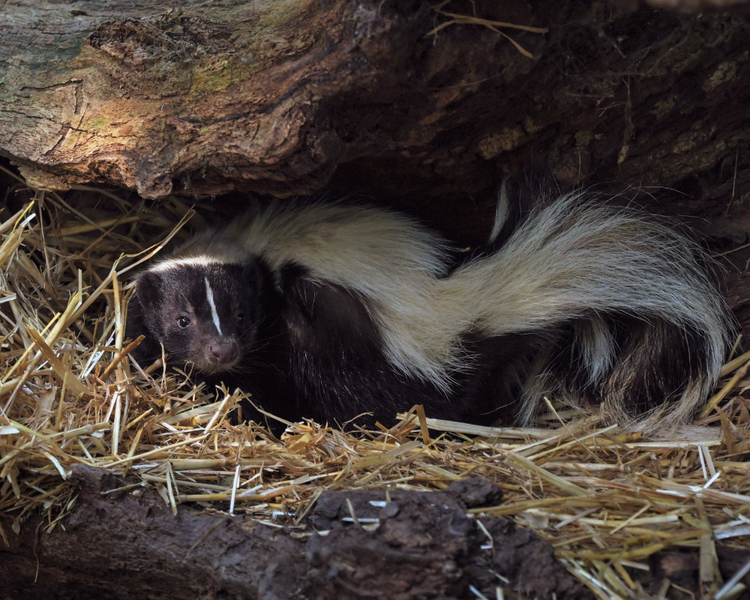
Quick answer: A skunk that moves under your Ontario deck or shed in September or October is choosing its winter den, and it will likely stay put until spring. The worst thing you can do is seal the opening — you either trap the animal underneath your structure or force it to dig out somewhere new. The right sequence is: confirm it is actually there, confirm it is alone, install a one-way door so it can leave but not return, then permanently screen the perimeter once it is out. Fall is genuinely the best window of the year to do this, because there are no dependent young underneath. Wait until spring and there will be.
Most people discover the skunk in one of two ways. Either the smell arrives first — a low, persistent odour near the back of the house, strongest on damp evenings — or the dog finds it, and the evening ends with peroxide and a garden hose.
Either way, you have a decision to make sooner than you think. Skunk complaints climb sharply across the GTA, York Region and Simcoe County from mid-September onward, and the reason is not random. This is denning season, and what you decide in the next few weeks determines whether you are dealing with one animal now or a family in May.
Why fall is the decisive month
Striped skunks do not truly hibernate. They find a sheltered, insulated space in autumn and spend most of the Ontario winter in it, dropping into reduced activity and emerging only during mild stretches. They want somewhere dry, enclosed, and — critically — already dug out or easy to dig into.
A deck with an open skirt, a shed on blocks, a porch with a gap at one corner, a hot tub pad, concrete steps with a void beneath: from a skunk’s point of view these beat anything available in the wild. No digging, no predators, and a roof.
Here is the part homeowners underestimate. Skunks breed in late February and March, and litters of four to seven kits arrive around early May. If a female dens under your deck in October and stays, you do not have a skunk problem in spring — you have a skunk nursery under a structure you cannot easily reach, and exclusion work cannot responsibly proceed with dependent young underneath. You are now waiting until late June, having spent two months with the smell.
That is why the fall window matters. Right now the animal is almost certainly alone or with one or two others, all fully mobile. There is nothing to strand. From roughly February onward, that stops being true.
First: confirm what is actually under there
Do not assume. We are called out to “skunk under the deck” jobs that turn out to be a groundhog, an opossum, or an empty hole from three seasons ago.
Look at the entry hole. A skunk’s working entrance is typically 10 to 15 cm across, low to the ground, often at a corner or where the skirting meets a post, with a fan of loose soil pushed out behind it.
Do the tracking-patch test. Smooth a layer of fine soil or flour across the opening at dusk and check it after dark and again at first light. Skunk front tracks show five toes with long claw marks well ahead of the pad — almost like a tiny bear print. Disturbed outward only means the animal has left and not returned; disturbed both ways means something is actively coming and going.
Count the occupants. Sit inside with the lights off around dusk for two or three evenings and watch the hole. It is tedious and it is the only way to know whether you have one animal or three. This is where DIY jobs most often fail: the homeowner sees one skunk leave, seals the hole, and the second one spends the night digging out through the deck boards.
Check whether the lawn is also being dug. Skunks that den on a property usually feed on it too, and fall is peak grub season. If you also have small cone-shaped holes across the lawn, the two problems are connected — we cover the diagnosis in what’s digging up your lawn at night. Clearing the den without addressing the food source leaves the property attractive to the next animal through.
Our skunk profile in the pest library has identification details if you want to be certain before you act.
What not to do
Do not seal the hole. This is the most expensive mistake available to you. Seal a skunk under a deck and one of three things happens: it dies under the structure, producing an odour problem lasting weeks that is unreachable without dismantling the deck; it digs out somewhere worse; or it sprays repeatedly in a confined space under your living area, which soaks into soil and framing and lingers for months.
Do not live-trap and drive it somewhere. It does not work. Ontario’s wildlife legislation requires an animal captured on your property to be released within one kilometre of where it was caught — so the skunk you removed on Sunday can be back under the deck by Wednesday, and the den is still open. Ontario’s guidance on preventing and managing conflicts with wildlife is blunt: exclusion and habitat modification work; removal alone does not.
Do not flush it out with poison, smoke, or anything you saw online. Poisoning wildlife is illegal in Ontario, and a poisoned animal dies in the least accessible place available.
Do not corner it. Skunks are not aggressive and would rather leave. Spraying is a last resort — they stamp their front feet, hiss, and raise the tail as warnings first. If you see that sequence, back away slowly; you have a couple of seconds and about five metres of range. Skunks are also a rabies vector species in Ontario, which is a further reason never to handle one or let a pet engage.
The sequence that actually works
1. Confirm occupancy and count. As above. Nothing else happens until this is settled.
2. Install a one-way door over the main entrance. This is a purpose-built device that lets the animal push out and not back in. Every other opening around the structure has to be closed at the same time, or the animal simply uses a different door. This is the technical heart of the job and the step where DIY attempts most often go sideways.
3. Give it three to five nights, confirming departure. The tracking patch does this for you. In cold weather a denned skunk may not come out every single night, so patience matters — sealing too early is the same mistake as sealing blind.
4. Screen the perimeter permanently. Heavy galvanized mesh, buried and turned outward into an L-shape at the base so the next animal cannot dig under it. Skirting that sits on top of the soil is decoration, not a barrier. This step determines whether you do this once or every second autumn.
5. Remove what made the property attractive. Grub-heavy lawn, accessible garbage or green bin, fallen fruit, pet food left outside, open compost. Structure plus food is what makes a property a destination.
6. Deal with residual odour properly. Skunk spray is a mix of sulphur-containing thiols, and neither tomato juice nor air freshener touches them. A fresh mix of hydrogen peroxide, baking soda and a little dish soap chemically neutralises the compounds, which is why it works where masking agents do not. Soil under a repeatedly sprayed deck may need removing.
Prevention, and the honest economics
If you have no skunk right now, make the fall decision before the skunk does. Screen deck skirting, close the gap under the shed, fill the void beside the steps — in September that is carpentry. In November it is a wildlife job. In May it is a wildlife job you cannot responsibly start.
We handle skunk and wildlife exclusion across Toronto, Vaughan, Innisfil and Whitby, and the pattern is identical everywhere: the properties we visit twice are the ones where the animal was removed and the structure was never sealed.
We do not publish a flat price for wildlife exclusion, and it would be misleading if we did — a deck with 40 feet of skirting and a shed on four blocks are different jobs. What is fixed is the front end: a $95 inspection, credited in full when you book the work.
Worth thinking about beyond the immediate job is the second wave. A void that has held a skunk has almost always been holding mice too — same gap, same shelter — and mice move indoors as the weather turns. Complete Mice Protection at $895 per year keeps that side of it out of the house all winter; our Essentials plan at $1,195 covers the broader seasonal pressure. The exclusion work stops this animal. The plan is what stops the next thing that finds the same gap.
Two minutes with our free quote quiz gives you a realistic picture of what your property needs, or see the full wildlife removal service. To just describe what you are hearing and smelling to a person, call (705) 302-1887.
Frequently asked questions
Will the skunk leave on its own before winter? Probably not. A denned skunk in Ontario typically stays through the cold season and becomes active again in late winter, which coincides with breeding. Waiting it out usually means waiting until there are more skunks, not fewer.
Can I seal the hole once I see the skunk leave at night? Not safely. You may have counted one animal when there are two, and a single unseen occupant sealed under a deck becomes a far larger problem. A one-way door achieves the same outcome without the risk.
Is it legal to trap and relocate a skunk in Ontario? Ontario’s wildlife rules require an animal captured on your property to be released within one kilometre of where it was caught, which usually means it returns. Exclusion is the approach that holds.
How do I get skunk smell out of my dog and off my deck? Hydrogen peroxide, baking soda and a little dish soap, mixed fresh and used immediately — it neutralises the sulphur compounds rather than masking them. Tomato juice does not work. Heavily sprayed soil under a structure sometimes has to be excavated.
What does skunk removal cost? It is quoted after a $95 inspection, credited in full when you book the work, because the structure determines the job. Screening 40 feet of deck skirting and closing one gap under a shed are not the same price.
Is fall really better than waiting for spring? Yes. In fall the animals underneath are mobile and can leave on their own. From roughly February onward, dependent young may be present, and exclusion work cannot responsibly proceed until they are old enough to walk out — which pushes resolution into early summer.
⚡ NO PHONE CALL NEEDED
Know your exact price in 60 seconds3 quick questions — matched to the right treatment with real, published pricing. Instantly.
Take the Quiz📖 FREE EXPERT RESOURCE
Identify any Ontario pest69 free identification guides — photos, habits, risks and prevention. No sales pitch, just answers.
Browse the Pest Library🛟 HELP CENTRE
Before & after your visitPrep checklists, what to expect and aftercare — written by our technicians so your treatment works the first time.
Visit the Help CentreFix it today. Keep it fixed all year.
Sani IQ Protect: from $77/month, with FREE rodent prevention. Smarter Protection.
Quarterly service handles ants, spiders and wasps before summer and keeps mice out before the first frost, with free re-service if anything returns between visits and a photo report every time. Mice already inside? Protect Plus removes them and keeps them out.