
Overview
The raccoon is Ontario’s most adaptable urban mammal and its most damaging attic invader. Intelligent, dexterous, and strong enough to peel back a soffit or lift a loose vent, a raccoon treats a home the way it would a hollow tree — as a warm, dry, predator-free place to den and, in spring and summer, to raise a litter. Toronto has one of the densest urban raccoon populations in North America, and the GTA’s ravines, mature canopy, and mix of older and newer roofs give the animals continuous travel routes right onto residential rooflines. Overhead thumping at night, a torn vent, or droppings on the deck are how most Ontario raccoon problems announce themselves — and by then a den is usually already established.
Identification
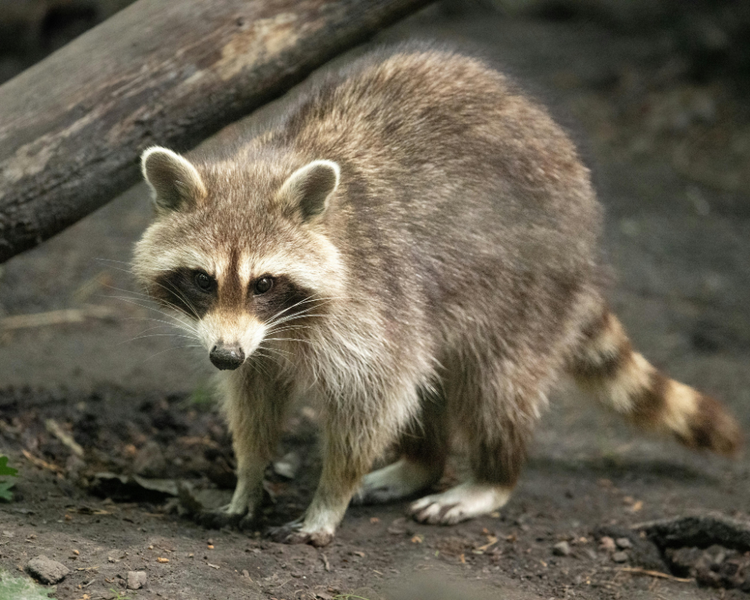
A raccoon is unmistakable at close range: 5–12 kg, grey-brown, with a black “bandit” mask across the eyes and a bushy, black-ringed tail. But most homeowners never see the animal — they hear it and find its damage. That’s where telling a raccoon from a squirrel matters, because the two call for different removal plans.
| Feature | Raccoon | Squirrel |
|---|---|---|
| Weight | 5–12 kg | 300–600 g |
| Attic sound | Heavy thumps, dragging, chittering | Quick, light scurrying |
| Active | Night, dawn & dusk | Daytime |
| Entry damage | Torn soffits, pried vents | Gnawed 40 mm holes |
| Droppings | Large, tubular, in a latrine | Small, scattered pellets |
The daytime-versus-night distinction is the fastest tell. Persistent daytime activity on the roof, however, can mean a nursing raccoon mother coming and going, so timing alone isn’t conclusive — a licensed inspection confirms the species and checks for young.
Life Cycle
Raccoons mate in late winter, and females give birth to litters of typically three to five kits after about a two-month gestation, with birthing periods in spring and again around June in Ontario. Kits are helpless for weeks, remaining dependent on the mother well into summer before they begin to forage and eventually disperse. This dependency is the single most important fact for removal: for a stretch of every summer, pulling the adult without the kits guarantees orphaned young trapped in your insulation. Raccoons can live several years in the wild and readily return to a productive den site year after year if it isn’t sealed.
Habitat & Behaviour
Raccoons are nocturnal, solitary outside of the mother-and-kits family group, and highly territorial about a good den. In Ontario’s cities and suburbs they exploit attics, chimneys, spaces under decks and porches, and sheds, moving between multiple den sites within their range. They are strong climbers and problem-solvers — capable of opening latches, turning knobs, and defeating flimsy vent covers — which is why “raccoon-proof” hardware has to be genuinely sturdy. A chimney without a proper cap is a favourite: it reads to a raccoon as a hollow, sheltered tree cavity.
Diet
Raccoons are opportunistic omnivores. They eat fruit, nuts, insects, grubs, eggs, small animals, and — in urban Ontario — whatever people leave accessible: unsecured green bins, compost, pet food, and fallen birdseed. Easy food is what draws raccoons onto a property in the first place and keeps them returning, which is why securing bins and removing outdoor food sources is a core part of prevention.
Signs of Infestation
- Heavy thumping, dragging, or chittering overhead at night — the classic raccoon signature, distinct from a squirrel’s lighter daytime scurry.
- A latrine — raccoons repeatedly defecate in one spot, leaving a pile of large droppings in the attic, on the deck, or on the roof. This is a roundworm hazard.
- Torn soffits, lifted shingles, or pried-open vents at the roofline, larger than any rodent would make.
- Greasy rub marks and paw prints near roof edges, downspouts, and entry holes.
- Daytime roof activity — a strong sign of a nursing mother.
- Stained ceilings from urine soaking through insulation.
Damage Caused
A denning raccoon is destructive out of proportion to its stay. It tears open soffits and fascia to get in, shreds insulation to build a nest, and gnaws structural wood and — dangerously — electrical wiring, which is a documented fire hazard. Urine and a growing latrine soak into insulation, staining ceilings and often requiring the insulation to be removed and replaced entirely. A single season with a family of raccoons overhead can turn into a multi-thousand-dollar attic restoration once decontamination and re-insulation are counted.
Health Risks
This is where raccoons earn their “High” danger rating. Roughly 95% of raccoon feces in Ontario carry raccoon roundworm (Baylisascaris procyonis), a parasite whose eggs can survive for years and cause a difficult-to-treat, potentially fatal infection in humans and pets who accidentally ingest them. A raccoon latrine is therefore a contamination event, not a mess — it demands professional decontamination with proper protective equipment. Raccoons are also one of Ontario’s rabies carriers; a raccoon out in daylight that appears disoriented, unusually tame, or aggressive should be treated as a possible rabies case and never approached, as our wildlife rabies safety guide explains.
Seasonal Activity in Ontario
Raccoons are active year-round in Ontario, denning up during the harshest cold snaps but never truly hibernating. The pressure on homes peaks twice: in spring as females seek birthing dens, and again around late June, a second birthing period that makes mid-summer prime attic-invasion season. Fall drives raccoons to fatten up and secure a warm winter den, putting attics and chimneys back in the crosshairs. Across the GTA — Toronto, Vaughan, and York Region towns like Newmarket, where ravine corridors run right into neighbourhoods — this cycle repeats every year, which is why one-time removal without sealing rarely holds.
Where They Hide
Indoors and around the structure: attics, uncapped or poorly-capped chimneys, spaces beneath decks, porches, and sheds, and occasionally wall voids or crawl spaces. Outdoors they shelter in hollow trees, brush piles, and storm sewers, using several den sites across their territory and shifting between them.
How They Enter Homes
Raccoons get in at the roofline, where they have the strength to create their own opening. Common routes are torn or aged soffits, loose or unscreened roof and gable vents, rotted fascia, roof-edge lift, and uncapped chimneys. Overhanging branches let a raccoon reach the roof in the first place, and any existing weak spot — a vent with flimsy screening, a gap where the roof meets the soffit — is an invitation.
Prevention Tips
- Cap the chimney with a sturdy, animal-proof chimney cap.
- Screen and reinforce roof, gable, and soffit vents with heavy-gauge material a raccoon can’t pry loose.
- Trim branches back at least a couple of metres from the roof so raccoons can’t jump across.
- Secure green bins, compost, and pet food; don’t leave food or birdseed accessible overnight.
- Repair rotted fascia, lifted shingles, and soffit gaps before an animal exploits them.
- Do a dawn-and-dusk listen and a binocular scan of the roofline each spring to catch problems early.
- Never seal a suspected entry until you’re certain no animal — or litter — is inside.
DIY vs. Professional Treatment
DIY raccoon removal is a trap for homeowners on every front. Store-bought traps frequently orphan kits during maternity season, leaving them to die and decompose in the walls; Ontario’s one-kilometre, 24-hour release rule means you can’t legally solve the problem by relocating the animal across town; and a raccoon latrine handled without proper PPE is a genuine roundworm exposure. Professional removal identifies the den and every entry point, removes the family together and humanely, decontaminates any latrine, and seals the roofline permanently so the next raccoon can’t move in. Sani IQ backs its wildlife work with the Pest-Free-Or-It’s-Free guarantee. For the local picture, see our guides on attic wildlife across Ontario and raccoons and squirrels in Newmarket attics.
References
- Government of Ontario — Rabies in Ontario
- Ontario — Harass, capture or kill a wild animal damaging private property
- Worms & Germs Blog — Raccoon Roundworm (Baylisascaris procyonis)
Last updated: July 16, 2026 · Reviewed by Sani IQ licensed technicians