
Overview
Bats are the one attic tenant where the law, not the homeowner, sets the timeline. Ontario’s two common house-roosting species — the little brown bat and the big brown bat — seek out attics, soffit cavities, ridge vents, and chimney gaps as summer roosts, and a single colony can persist for years in an older roofline. They are legally protected, the province’s leading rabies carrier, and their droppings pose a genuine lung-infection risk. That combination means a bat problem cannot be handled the way you’d handle mice: it’s solved by humane exclusion inside a narrow legal window, never by trapping or a quick seal. Scratching or high-pitched squeaks in the attic at dusk, or droppings under a soffit, are the usual first signs.
Identification
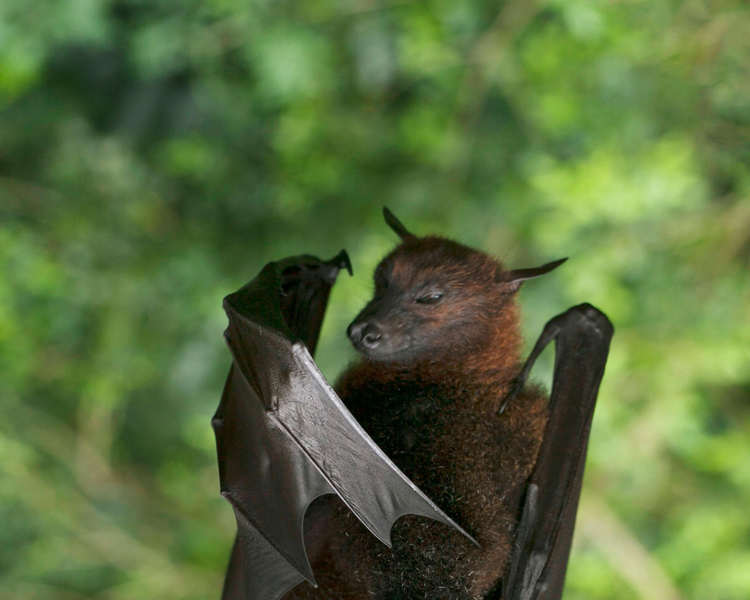
Homeowners rarely get a close look at a bat, but the signs are distinctive and easy to separate from a rodent. Bats are small — 5 to 30 grams — with brown fur and leathery wings, and they enter and exit at dusk rather than moving across the ceiling like a squirrel.
| Sign | Bats | Squirrels/Mice |
|---|---|---|
| Sound | High-pitched squeaks, faint fluttering at dusk | Scurrying, gnawing, thumps |
| Activity | Emerges at dusk, returns before dawn | Squirrels by day, mice by night |
| Droppings | Small, dark, crumbly, cluster below roost | Rod-shaped, scattered along runs |
| Entry point | Gaps ~1 cm at soffits, ridge vents, chimney | Gnawed 40 mm holes, torn soffits |
| Stains | Dark greasy staining at entry hole | Gnaw marks around entry |
Bat droppings crumble to a fine powder when touched and often pile directly beneath the roost, whereas rodent droppings are firmer and scattered along travel routes. A dark, greasy stain at a soffit or ridge gap — from the oils in bats’ fur as they squeeze through — is a strong indicator of an active entry.
Life Cycle
Bats gather into maternity colonies in spring, and females give birth in early summer, typically to a single pup. Those pups are flightless for several weeks — the biological fact behind the exclusion ban — and only become capable of flying and feeding on their own from around mid-August. This is why the legal exclusion window opens mid-August: it’s the point at which sealing the roost no longer traps helpless young inside. In fall, bats leave summer roosts to hibernate through winter, then return, often to the same building, the following spring. Bats are long-lived for their size, which is part of why an unsealed roost recurs year after year.
Habitat & Behaviour
House-roosting bats favour warm, sheltered cavities: attics, soffit and ridge-vent voids, chimney gaps, and behind fascia and flashing. They are colonial — a maternity colony can number dozens or more — and they’re nocturnal, emerging at dusk to feed and returning before dawn, which is why sightings and squeaking peak at those hours. Bats can enter through gaps as small as roughly a centimetre, so exclusion depends on meticulously mapping and sealing every opening, not just the obvious one.
Diet
Bats are insectivores and, ecologically, a major asset — a single little brown bat can eat hundreds of insects, including mosquitoes, in a night. This is part of why Ontario protects them: they provide free, large-scale insect control. Their diet has nothing to do with your home; they roost in the structure and hunt outdoors, so there is no food source inside to remove. The attraction is purely the shelter the roofline provides.
Signs of Infestation
- High-pitched squeaks or faint fluttering in the attic or walls, especially around dusk — the most reliable early sign.
- Bats seen emerging from a soffit, ridge vent, or chimney at dusk — watch the roofline at sunset to map exits.
- Droppings (guano) accumulating under a soffit, on a windowsill, on the deck, or across attic insulation.
- Dark, greasy staining around a gap at the roofline from repeated entry.
- A bat inside a living space — often the first sign of a roost nearby, and always a possible rabies exposure.
- A faint ammonia odour from accumulated guano in the attic.
Damage Caused
Bats don’t gnaw wood or wiring the way rodents do, so structural damage is limited — the harm is contamination. Accumulated guano and urine soak into insulation, staining ceilings, generating a strong ammonia odour, and often requiring the insulation to be removed and replaced as part of decontamination. Over years, a large colony can leave a substantial guano deposit that is both a clean-up cost and a health hazard. The financial impact is real, but it’s the health and legal dimensions, not structural ruin, that define a bat problem.
Health Risks
This is where bats earn a “High” rating. According to the Government of Ontario, of the 121 rabies cases confirmed in the province in 2025, 116 were the bat variant — the overwhelming majority of Ontario’s rabies risk traces to bats. A bat bite can be so small it leaves no visible mark and is never felt, which is why public health treats certain indoor bat encounters — especially involving a sleeping person, child, or pet — as possible exposures even with no obvious bite. Separately, accumulated guano can harbour the fungus that causes histoplasmosis, a lung infection contracted by inhaling spores from disturbed droppings, with higher risk for older adults, infants, and the immune-compromised. Our detailed guides cover what to do about a bat in the house and cleaning guano safely.
Seasonal Activity in Ontario
Bat activity in Ontario runs from roughly April, when bats emerge from hibernation, through October. May to mid-August is maternity season, when flightless pups are in the roost and exclusion is prohibited. Mid-August through October is the legal exclusion window — pups can fly, the colony is fully active, and one-way exclusion can lawfully proceed. November through April is hibernation, when bats won’t leave and sealing is pointless (and risky if any remain). This tight calendar is why booking a licensed inspection early is so important: it maps entries and identifies the species so the crew can act the day the window opens, instead of joining the queue once every homeowner notices their bats at once.
Where They Hide
Attics are the primary roost, along with soffit and ridge-vent cavities, chimney gaps, and the spaces behind fascia, flashing, and loose siding. Bats tuck into warm, dark, sheltered pockets high in the structure, often near the ridge where heat collects. Older GTA and Simcoe County homes with aging soffits, ridge vents, and uncapped chimneys are the roosts we see most often.
How They Enter Homes
Bats exploit existing gaps rather than making their own. Common entries are openings around a centimetre wide at soffit-to-roof junctions, ridge and gable vents, uncapped or gapped chimneys, and behind fascia, flashing, and lifted shingles. Because the openings are small and often high on the roof, mapping every one — typically by watching the dusk emergence — is the core of a successful exclusion.
Prevention Tips
- Book a licensed inspection at the first sign of bats to map entries and confirm the species — don’t wait.
- Do not seal any suspected entry during maternity season (May to mid-August); you’ll trap flightless pups.
- Watch the roofline at dusk and note every exit point, but don’t block them.
- Keep people and pets out of an affected attic space.
- After a confirmed exclusion, seal all gaps down to roughly a centimetre — soffits, ridge vents, chimney, fascia.
- Cap the chimney and screen ridge and gable vents to prevent future roosting.
- If a bat gets into a living area, isolate the room and contact public health before releasing it.
DIY vs. Professional Treatment
With bats, DIY isn’t just inadvisable — it’s illegal. Killing, trapping, poisoning, or relocating bats violates Ontario’s Fish and Wildlife Conservation Act, and sealing an active roost traps the colony (and, in summer, flightless pups) inside your walls. Lawful, humane exclusion is a defined process: a licensed inspection identifies the species and every entry point and confirms whether pups are present; one-way devices are installed at active exits only inside the legal window; bats leave to feed and can’t re-enter; the colony is confirmed clear; all entries are permanently sealed; and guano is decontaminated by technicians in proper PPE. Sani IQ handles the full job lawfully and backs its wildlife work with the Pest-Free-Or-It’s-Free guarantee; bat work is quote-based after inspection, with standard pricing on our plans and pricing page. The legal timing is explained in full in our guide on the bat exclusion window.
References
- Ontario — Fish and Wildlife Conservation Act, 1997
- Government of Ontario — Rabies in Ontario
- Ontario — Little Brown Myotis (little brown bat)
- CDC — Histoplasmosis Prevention
Last updated: July 16, 2026 · Reviewed by Sani IQ licensed technicians