
Overview
Pavement ants are the small, dark ants most Ontario homeowners actually have in mind when they say “ants in the kitchen.” True to their name, they nest beside and beneath sidewalks, driveways, patios, slabs, and foundations — exactly the sun-baked hardscape that surrounds most GTA homes. From those nests they send foraging trails toward the nearest reliable food and water, which in summer means straight through your door threshold and across the counter. They don’t damage your home and they can’t hurt you, but a pavement ant colony is persistent, long-lived, and quick to announce itself with a dramatic June swarm. Understanding what the trail and the swarm are telling you is the difference between a quick fix and a repeat performance every summer.
Identification
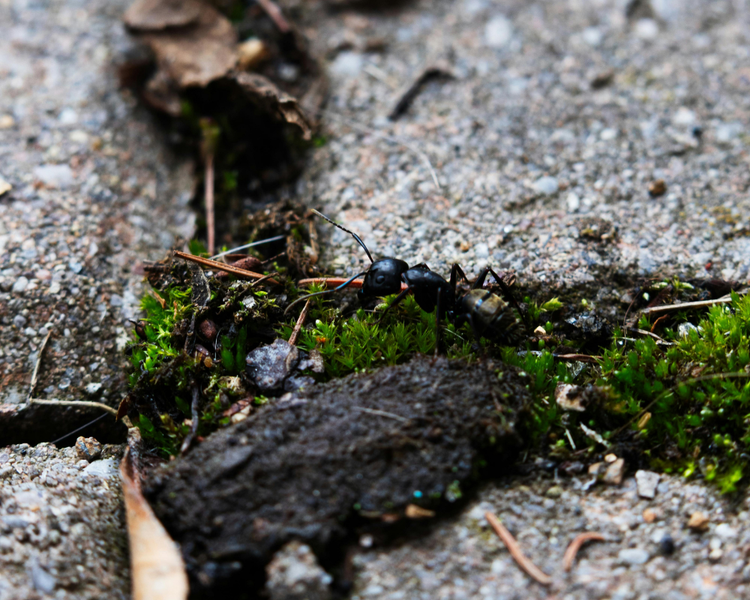
Pavement ants are small — workers run 2.5 to 4 mm — and range from dark brown to black. Under magnification you can see fine parallel grooves on the head and thorax and a pair of small spines on the back; the body carries a two-segmented waist. In practice, most people identify them by size and place: tiny dark ants trailing along a driveway crack, patio seam, or baseboard. The most common confusion is with the much larger, more damaging carpenter ant.
| Feature | Pavement Ant | Carpenter Ant |
|---|---|---|
| Size | Small, 2.5–4 mm | Large, 6–17 mm |
| Colour | Dark brown to black | Jet black or red-and-black |
| Nest site | Under pavement, slabs, soil | Moist or damaged wood |
| Activity | Daytime trails | Mostly at night |
| Structural risk | None — nuisance only | High — excavates wood |
If the ants you’re seeing are large, black, active after dark, or paired with fine sawdust, read our carpenter ants guide instead — that’s a structural problem, not a patio one.
Life Cycle
A pavement ant colony grows over several years to hold thousands of workers and, in mature colonies, more than one queen. Only an established colony produces winged reproductives, and it releases them in a synchronized nuptial flight in June and July, typically on a warm day after rain. Winged males and queens surface through pavement cracks to mate; the males die shortly after, and each fertilized queen sheds her wings and digs in to found a new colony. That timeline is why a swarm on your property is useful information — it confirms the colony beneath your hardscape is old enough and large enough to reproduce.
Habitat & Behaviour
Outdoors, pavement ants nest in soil sheltered by a slab, stone, or curb, and under mulch and landscape edging. The warmth radiating off concrete makes driveways and patios ideal nurseries. Colonies are territorial and famously wage “sidewalk wars” — mass border skirmishes between neighbouring nests you can sometimes see as dark, writhing patches on a summer walkway. Foragers lay chemical scent trails between the nest and a food source, reinforcing the path with every trip, which is why one scout quickly becomes a marching line. The same cracks that release swarmers in June become the foraging highways that carry workers toward your kitchen in July.
Diet
Pavement ants are opportunistic feeders with a strong sweet tooth. They take honeydew from aphids, plus sugars, greasy and oily residues, meats, and pet food — essentially anything a kitchen offers. This broad appetite is why sanitation alone rarely stops them: they’ll work a single sticky jar rim or crumb under the toaster, and once a scent trail is established, pheromone-following workers keep arriving until the source and the trail are both removed.
Signs of Infestation
- Small sand or soil piles pushed up through cracks in driveways, patios, garage slabs, and along the foundation — the clearest sign of an active nest below.
- Daytime trails of tiny dark ants running along baseboards, counters, and door thresholds toward food or water.
- Winged swarmers erupting from pavement cracks in June and July, or accumulating at a garage or basement window.
- Reappearing trails in the same spot within days of cleaning — a sign the nest is intact and close by.
- Activity concentrated after hot, dry spells, when outdoor moisture dries up and foragers push indoors.
Damage Caused
Pavement ants cause no structural damage. They don’t excavate wood, chew wiring, or undermine slabs in any meaningful way — the sand they push up is cosmetic. The real cost is nuisance and contamination: trails across food-prep surfaces, ants in the pantry and pet bowls, and the steady spread of new colonies across a property as each summer’s swarm establishes more nests under the hardscape.
Health Risks
Pavement ants pose a very low health risk. They don’t sting, their rare bite is harmless, and they carry no significant disease burden for a typical household. The one honest caveat is food contamination — ants foraging across counters and through stored food can transfer surface bacteria, which matters most in commercial kitchens and restaurants under health inspection, where any visible ant activity is a compliance issue.
Seasonal Activity in Ontario
Pavement ants become active with the spring thaw in April and forage through October. Colonies build through May, swarm in June and July, and reach peak indoor pressure in the heat of mid-summer, when a warm, humid GTA stretch or a dry spell pushes foragers inside for water. Older neighbourhoods with cracked walkways and mature landscaping — common across Mississauga, Hamilton, and Durham Region — tend to see it first, because there’s simply more hardscape to nest under. Activity tapers through late summer and fall as temperatures drop and the colony settles back for winter.
Where They Hide
Outdoors: beneath driveway and patio slabs, under paving stones, curbs, and landscape edging, along foundation walls, and under mulch, logs, and firewood. Indoors, when they move in, they nest in wall voids and under flooring near the foundation, and beneath slab-on-grade floors — usually within a short forage of an exterior nest rather than deep in the structure.
How They Enter Homes
Pavement ants follow the cracks they already nest in. They enter through expansion joints and gaps in slab floors, foundation cracks, weep holes, and gaps around door thresholds, basement windows, and utility penetrations. Trails often run from a driveway or patio nest straight to the nearest door. Because they’re already living against the foundation, exclusion works best paired with a perimeter treatment that reaches the nest itself.
Prevention Tips
- Seal cracks in driveways, walkways, patios, and the garage slab where ants nest and emerge.
- Caulk gaps around door thresholds, basement windows, foundation cracks, and pipe penetrations.
- Keep mulch, soil, stone, and firewood pulled back from the foundation.
- Fix leaks and direct downspouts away from the slab — foragers follow moisture indoors during dry spells.
- Store sugar, honey, and pet food in airtight containers, and wipe up crumbs, grease, and sticky spills daily.
- Wipe indoor trails with soapy water or vinegar to erase the scent path (a stopgap, not a cure).
- Book a perimeter treatment if the same spot swarms or trails year after year.
DIY vs. Professional Treatment
For a single early trail, careful baiting — never spraying — sometimes works: the right bait lets foragers carry the active ingredient back to the queen. But the colony lives under concrete you can’t lift, so DIY often means weeks of reapplication after every rain while trails keep returning from an intact nest. A professional treatment targets the source: the exterior perimeter and nesting cracks, not just the ants on the counter. Sani IQ backs pavement ant work with our Pest-Free-Or-It’s-Free guarantee. For the numbers, see our Ontario ant control cost guide and plans and pricing; if a swarm has you weighing options, our pavement ant swarm alert walks through what to do first.
References
- PestWorld / NPMA — Pavement Ants
- University of Minnesota Extension — Ants
- Penn State Extension — Pavement Ant
Last updated: July 16, 2026 · Reviewed by Sani IQ licensed technicians