
Overview
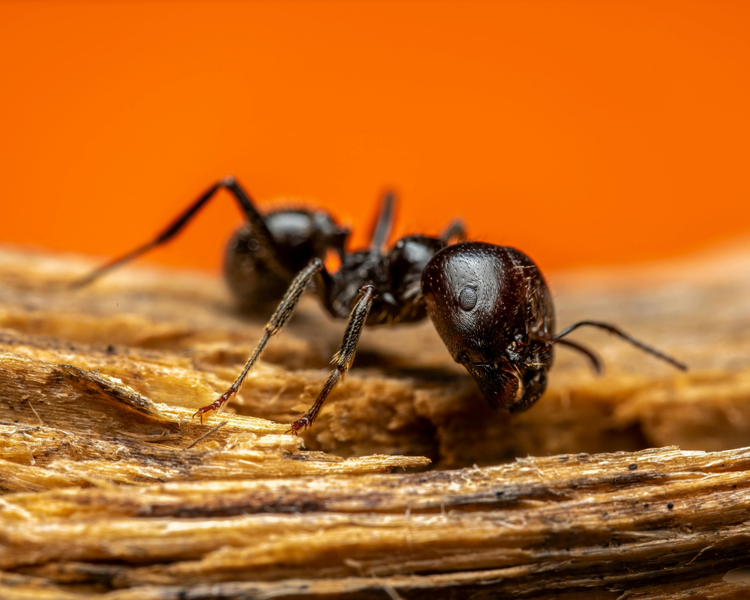
Carpenter ants are Ontario’s most damaging ant. The black carpenter ant (Camponotus pennsylvanicus) is one of the largest ants in eastern North America, and it earns its name by carving smooth galleries through moist or weakened wood to house its colony. It doesn’t eat the wood — it hollows it out, one gallery at a time, often for years before a homeowner notices. A steady trail of large black ants indoors, or a small pile of what looks like pencil shavings under a window sill, is how most Ontario infestations announce themselves.
Identification
Size alone rules out most look-alikes. Workers run 6–17 mm — several times larger than the pavement ants on your driveway — and queens reach 25 mm. Look for a single pinched waist node, a smoothly rounded back (thorax) with no bumps or notches, and elbowed antennae. Most Ontario carpenter ants are jet black; some species show a reddish-brown thorax with a black abdomen.
| Feature | Carpenter Ant | Pavement/House Ant |
|---|---|---|
| Size | Large, 6–17 mm | Small, 2–4 mm |
| Thorax profile | Evenly rounded arch | Uneven, bumpy |
| Colour | Jet black or red-and-black | Brown to black |
| When you see them | Mostly at night | Daytime trails |
They’re also easy to confuse with termite swarmers in spring. Carpenter ant swarmers have pinched waists, elbowed antennae, and front wings longer than the hind pair; termites have thick waists, straight antennae, and four equal wings. The distinction matters — the treatments differ completely.
Life Cycle
A queen starts a colony in a small cavity of damp wood, raising her first workers alone. The colony matures over three to six years to roughly 3,000 workers or more, and only a mature colony produces winged swarmers — typically 200 to 400 each spring. Eggs take about two months to become workers in summer conditions, and a queen can live and lay for over a decade. That timeline is why a single swarmer indoors is significant: it means a nest has been developing in or near your home for years.
Habitat & Behaviour
Mature colonies run on a parent-and-satellite system. The parent nest — queen and eggs — sits in consistently moist wood, usually outdoors in a stump, log, landscape timber, or damp structural wood. Satellite nests, holding workers, larvae, and pupae, extend into drier cavities: wall voids, hollow doors, attic insulation, window headers. The ants you see in your kitchen are almost always foragers from a satellite, connected to the parent colony by scent trails that can run 100 metres. Carpenter ants are primarily nocturnal, which is why sightings peak after dark.
Diet
Carpenter ants feed on sugars and protein: honeydew from aphids, plant juices, other insects (living or dead), and whatever your kitchen offers — sweets, meat, pet food, and grease. Foragers head out at dusk along established trails between the nest and food sources, following the same routes night after night.
Signs of Infestation
- Frass — fine, sawdust-like shavings mixed with insect parts, pushed out of slits in wood and piling up under sills, trim, or in the basement. This is the single most reliable sign.
- Large black ants indoors at night, especially in kitchens and bathrooms.
- Faint rustling inside walls or hollow doors on quiet evenings — large colonies are audible.
- Winged swarmers at windows in spring, the highest-urgency sign of a mature nest.
- Hollow-sounding wood that gives under light pressure when tapped.
Damage Caused
Galleries follow the soft grain of moist wood through sills, rim joists, deck framing, window and door headers, and porch columns. The damage compounds along two tracks at once: the excavation itself, and the underlying moisture problem that softened the wood in the first place. Ontario insurers generally treat insect damage as preventable maintenance — meaning repairs are out of pocket, and prevention is the only cheap option.
Health Risks
Carpenter ants don’t sting and rarely bite unless handled; a large worker’s bite can pinch and release formic acid, but it’s harmless. The real risk is structural, not medical — with one caveat: their foraging through kitchens can contaminate food surfaces, which matters for restaurants and commercial kitchens under health inspection.
Seasonal Activity in Ontario
Activity begins with spring melt in April, peaks May through September, and swarmers fly May to July. Ontario’s freeze-thaw springs and humid summers create exactly the damp-wood conditions the species needs. Cottage country — Muskoka, Orillia, Lake Simcoe — is especially exposed, where wooded lots and seasonally-closed cabins let colonies establish unnoticed; our Muskoka carpenter ant guide covers the cottage-specific playbook. Workers seen indoors in winter mean an interior satellite nest, full stop.
Where They Hide
Indoors: wall voids behind kitchens and bathrooms, window and door frames, sills and rim joists, hollow-core doors, attic insulation, and any wood touched by a past or present leak. Outdoors: stumps, firewood piles, fence posts, deck framing, and tree limbs contacting the roofline.
How They Enter Homes
Along branches and shrubs touching siding or roof, through foundation gaps and weep holes, around utility penetrations, under door thresholds, and via firewood carried inside. Moisture-damaged wood anywhere in the envelope is both the doorway and the destination.
Prevention Tips
- Fix leaks fast — roof, plumbing, chronic damp spots in walls or basement.
- Clear gutters and downspouts so water drains away from the foundation.
- Cut back branches and shrubs touching the roof or siding.
- Store firewood off the ground, away from the house — and inspect it before bringing it in.
- Seal gaps around pipes, wires, windows, and the foundation.
- Replace water-damaged wood rather than painting over it.
A spring walk-around covering these six items takes twenty minutes and removes the reason a queen would choose your house. Our DIY pest prevention guide covers the full-home version.
DIY vs. Professional Treatment
You can knock down visible foragers with store sprays, but that rarely reaches the parent nest — often outdoors and out of sight — so the queen keeps producing workers while galleries spread behind drywall. Professional treatment traces trails to the source, treats parent and satellite nests directly, and identifies the moisture condition that invited them. Sani IQ backs carpenter ant work with our Pest-Free-Or-It’s-Free guarantee. For an honest look at the trade-off, read can you get rid of carpenter ants yourself? — and for numbers, the 2026 treatment cost guide.
References
- Health Canada — Carpenter Ants
- University of Minnesota Extension — Carpenter Ants
- NC State Extension — Biology and Control of Carpenter Ants
Last updated: July 16, 2026 · Reviewed by Sani IQ licensed technicians