
Overview
“Flying ants” aren’t a species at all — they’re the winged reproductives that every mature ant colony sends out once a year to mate and found new nests. Ontario homeowners meet them as a sudden shimmer of winged insects on the driveway in late June, or, more alarmingly, as a cluster of them crawling on the inside of a living-room window. That distinction is the whole point of this page. An outdoor swarm is harmless summer biology that’s over in hours. Winged ants emerging inside your home mean an established colony has been nesting in or against the structure long enough to reproduce — and if they’re large and black, that colony may be carpenter ants working through your framing. Reading the swarm correctly, and telling it from a termite swarm, is what turns a startling sight into a useful early warning.
Identification
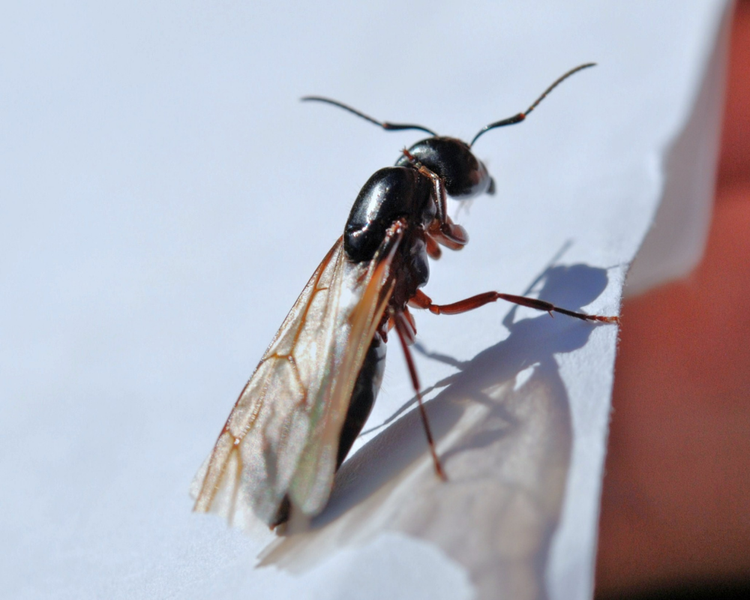
Flying ants are winged versions of ordinary ants, so identification runs two steps: confirm it’s an ant (not a termite), then work out which ant. Every flying ant shares the ant body plan — a pinched, hourglass waist, bent (elbowed) antennae, and front wings noticeably longer than the hind pair. The single most important comparison is against termite swarmers, because Ontario does have the eastern subterranean termite in the south, and the two demand completely different treatments.
| Feature | Flying Ant (Swarmer) | Termite Swarmer |
|---|---|---|
| Waist | Pinched, hourglass | Broad, no waist |
| Antennae | Bent / elbowed | Straight, beaded |
| Wings | Front pair longer than hind | Both pairs equal length |
| Colour | Black, brown, or reddish | Pale, milky white |
| Behaviour | Active, runs quickly | Sluggish, sheds wings fast |
Once you’ve confirmed it’s an ant, size and colour point to the species: large (13–20 mm) black swarmers are carpenter ants, while small dark swarmers erupting from driveway cracks are usually pavement ants. Our carpenter ants vs. termites guide covers the full comparison if you’re unsure.
Life Cycle
Winged ants are a colony’s reproductive stage, and a colony only produces them once it’s mature — generally at least two to three years old and well established. Mature nests raise winged males and queens (alates) and hold them until weather conditions align, then release them all at once in a synchronized nuptial flight. The swarmers fly, mate on the wing or shortly after landing, and the males die within days. Each fertilized queen sheds her wings and attempts to found a new colony in a suitable cavity. That maturity requirement is the key insight for homeowners: a swarm near your home means a colony has been quietly thriving close by — or inside — for years.
Habitat & Behaviour
Swarmers themselves don’t nest, forage, or persist — their entire adult job is the mating flight. Where they emerge from is the diagnostic. Outdoor swarms rise from established nests in soil, pavement cracks, stumps, and dead wood, and disperse on the breeze. Indoor swarms come from a nest within the structure: carpenter ants in damp framing, or other species in wall voids, under floors, or around plumbing. Winged ants indoors gather at windows and light fixtures because they’re drawn to light while trying to get out — which is why interior glass covered in winged ants is such a classic sign of an interior nest. Swarms cluster on the warmest, most humid days because every colony responds to the same weather trigger.
Diet
Winged reproductives don’t meaningfully feed during their brief flight stage — their energy comes from reserves built up in the nest, and their sole purpose is to mate and disperse. The colony that produced them, however, forages according to its species: carpenter ants take sugars and protein, pavement and odorous house ants chase sweets and honeydew, and so on. This is why treating a swarm means treating the parent colony’s behaviour, not the swarmers — the flyers you see are a symptom with no appetite of their own.
Signs of Infestation
- Winged ants emerging inside the home — from walls, window frames, baseboards, or ceiling fixtures — the highest-urgency sign, indicating an interior nest.
- Winged ants clustered on interior windows or light fixtures, drawn to light while trying to escape.
- A synchronized outdoor swarm on a warm, humid afternoon — normal, but it confirms mature colonies nearby.
- Large black swarmers plus fine sawdust (frass) near baseboards or window frames — points to carpenter ants in structural wood.
- Shed wings on windowsills, counters, or floors after a swarm passes.
- Repeated indoor swarms in the same room over successive days or seasons.
Damage Caused
The swarmers cause no damage themselves — they don’t chew, excavate, or bite the structure. The damage question is entirely about the colony behind them. If the swarm is carpenter ants, the parent and satellite nests are excavating galleries through moist structural wood, and that damage accumulates over seasons across sills, joists, and headers. If the swarm is pavement or odorous house ants, there’s no structural damage, only nuisance. This is exactly why identifying the swarmer matters: the same startling cloud of wings can mean “harmless” or “your framing is being hollowed out,” and only the body under the wings tells you which.
Health Risks
Flying ants pose essentially no health risk. They don’t sting or bite in any meaningful way, carry no significant disease as swarmers, and the flight passes within hours. The only real concern is the misidentification risk — mistaking termite swarmers for flying ants (or vice versa) and treating the wrong pest — plus the general food-surface contamination any ant activity brings, which matters most in commercial and food premises. For a household, the swarm is unsettling but harmless; its value is purely as information.
Seasonal Activity in Ontario
Ontario’s main flying-ant season runs May through July. Carpenter ants tend to swarm earliest — May and June, on warm humid mornings after a mild night — while pavement ants and many other species swarm in June and July, typically on warm, humid, low-wind afternoons above roughly 24°C, often a day after rain. Because colonies across a neighbourhood respond to the same weather cue, swarms are synchronized: the whole street can erupt on one sticky afternoon. Warm, mild seasons that let more colonies survive and mature can make a given year’s swarms look especially large. An indoor swarm out of season — including winter, in a heated building — is a strong sign of an interior nest such as carpenter ants or pharaoh ants.
Where They Hide
Before the flight, swarmers wait inside the parent nest — which is the location that matters. Outdoor nests sit in soil, under pavement and slabs, in stumps, logs, and dead limbs. Indoor nests hide in moisture-damaged framing, wall and ceiling voids, around window and door headers, under floors, and near plumbing and heat sources. When winged ants show up indoors, the spot they emerge from — a specific wall, window, or baseboard — points straight at where the hidden nest is, which is why noting the exact location is the most useful thing a homeowner can do.
How They Enter Homes
Outdoor swarmers can drift in through open doors and windows and around screens, but they don’t establish anything indoors and can simply be swept or vacuumed up. The swarmers that matter didn’t come from outside at all — they emerged from a nest already inside the structure, pushing out through gaps around window frames, baseboards, ceiling fixtures, and floor seams. So an indoor swarm isn’t really about “entry”; it’s about an interior colony revealing itself. The colony itself typically got in earlier through foundation cracks, utility penetrations, roof-contacting branches, or moisture-damaged wood.
Prevention Tips
- Don’t panic over an outdoor swarm — it’s harmless and gone within hours; sweep or vacuum the strays.
- Note exactly where indoor swarmers emerge — the spot points to the hidden nest.
- Capture a few in a container or photo; size and colour identify whether they’re carpenter ants.
- Don’t spray indoor swarmers — killing the flyers does nothing to the colony producing them.
- Fix moisture problems — leaks, damp framing, plugged gutters — that let interior colonies establish.
- Seal gaps around windows, doors, utility lines, and the foundation, and cut back roof-contacting branches.
- Book a professional inspection if winged ants emerge indoors, to locate and treat the nest.
DIY vs. Professional Treatment
For an outdoor swarm, there’s nothing to treat — it’s normal biology, and a broom is all you need. An indoor swarm is the opposite: it’s the clearest signal you’ll get that a mature colony is nesting in your home, and DIY sprays are precisely the wrong response, killing a few visible flyers while the queen and workers stay intact behind the drywall and keep coming. The right move is identification and an inspection — confirming the species (carpenter ants change the stakes to structural), locating the parent and any satellite nests, and treating the colony at its source. Sani IQ backs the work with our Pest-Free-Or-It’s-Free guarantee. If you’ve seen winged ants indoors, read what an indoor carpenter ant swarm really means and send us a photo for identification.
References
- University of Minnesota Extension — Carpenter Ants (swarmers)
- Health Canada — Carpenter Ants
- PestWorld / NPMA — Ant Pest Guide
Last updated: July 16, 2026 · Reviewed by Sani IQ licensed technicians