
How to Get Rid of Carpet Beetles — The Ontario Homeowner's Guide
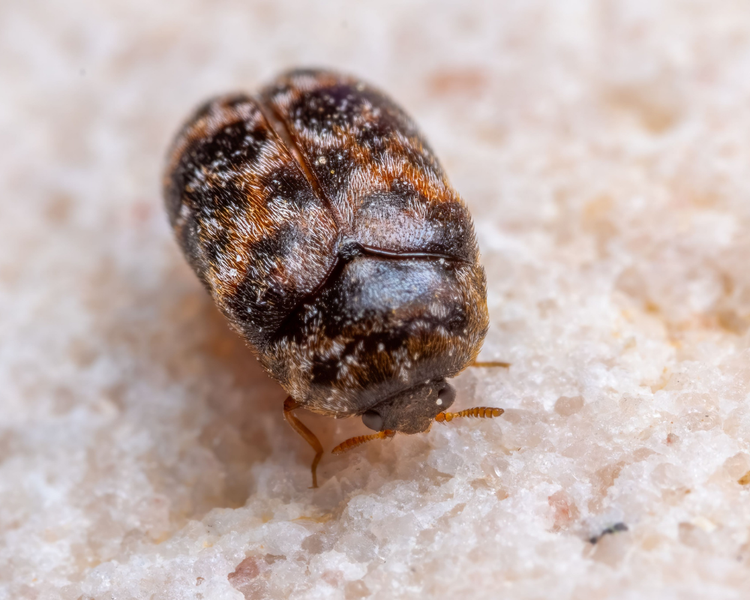
Quick answer: The adult beetles you’re seeing on a windowsill aren’t what’s eating your clothes — the larvae are, and they’re hiding somewhere you haven’t looked: under a rug edge, inside a closet baseboard, in a wool coat you haven’t worn since March, or in a dead bird or rodent in a wall void. Getting rid of carpet beetles is a source hunt, not a spray job. Find the protein the larvae are feeding on, remove it, launder or freeze everything washable, vacuum edges and crevices hard and repeatedly, and treat the harbourage — not the open floor. If damage keeps appearing after that, there’s a second source you haven’t found yet.
Carpet beetles are one of the most under-diagnosed pests in Ontario homes, for a simple reason: the damage shows up months before anyone identifies the cause. A sweater comes out of storage in October with holes in it and gets blamed on moths. By the time the real culprit is identified, the larvae have been feeding through two seasons.
Heating season is when it becomes visible — closets get opened, wool comes out of storage, and warm dry indoor air speeds up larval development.
The thing most people get wrong
Carpet beetles have a complete life cycle — egg, larva, pupa, adult — and two of those stages behave like completely different pests.
Adults are small (2–4 mm), rounded, mottled brown-black-and-cream or solid black. They eat pollen and nectar, fly toward light, and do no damage to your belongings at all. They’re drawn to windows because they’re trying to get out.
Larvae are the damage: tiny bristly caterpillars, tan to dark brown, 3–6 mm, covered in stiff hairs, often with a tuft at the rear. They avoid light, which is why they live under things, and they’re the stage that digests keratin.
So if you’re seeing adults at windows, that is not the start of an infestation — it means larvae somewhere in the house have already completed development. Spraying the windowsill changes nothing.
What they actually eat — and why your living room is fine
Carpet beetle larvae feed on animal protein:
- Wool, cashmere, alpaca, felt and wool-blend carpet
- Silk, feathers and down — pillows, duvets, cushions
- Leather, fur and hair, including taxidermy and wool wall hangings
- Dried pet food, plus the pet hair and dander that accumulates under furniture
- Dead insects, dead rodents and abandoned bird nests
That last category solves most stubborn cases. Modern Ontario homes are mostly synthetic — nylon broadloom, polyester upholstery — and synthetics are not food. So when an infestation persists in a house with no wool in it, the source usually isn’t textile at all. It’s a dead mouse in a wall void, a cluster of dead flies in a light fixture or attic, or an old bird or wasp nest in a soffit.
Which is why fabric-pest and rodent problems travel together. A rodent that died inside a wall after a poison baiting becomes a protein reservoir that can sustain carpet beetles for a year or more — one of several reasons we don’t recommend poison-first rodent work. If you’ve had mice in the past and now have unexplained fabric damage, the two are probably related, and the rodent side needs resolving first. Our mice control service in Etobicoke and its equivalents at our other branches deal with exactly this combination.
For side-by-side identification against clothes moths and other fabric-damaging insects, the carpet beetle page in our pest library has the detail.
Carpet beetles vs. clothes moths
These get confused constantly, and the fix differs.
| Clue | Carpet beetle | Clothes moth |
|---|---|---|
| Damage pattern | Irregular holes, often several together; surface grazing on carpet nap | Cleaner holes; silk tubes or webbing present |
| Webbing | None | Yes — silky tunnels, cases or mats |
| What you find | Shed bristly skins (often more than live larvae) | Silk cases, frass stuck in webbing |
| Where | Carpet edges, closet floors, under furniture, wall voids | Deep inside folded garments, dark closets |
| Adults seen | At windows, flying to light | Fluttering weakly in closets, avoid light |
Shed skins are the most useful diagnostic. Larvae moult repeatedly and the discarded skins accumulate. A scatter of hollow bristly husks along a closet baseboard or under a rug edge means carpet beetles — and you’ve found a feeding site.
The removal process that actually works
Step 1 — Find the source before you treat anything
This is 80% of the job. Work through, in order:
- Closet floors and corners — pull everything out, including what’s been at the back for a year.
- Carpet edges and under the tack strip, especially under furniture that never moves.
- Stored textiles — wool, down, costume items, inherited linens, sports gear, winter coats.
- Under and behind appliances — pet hair and dander mats accumulate there and are genuine food.
- Light fixtures, window cavities, attic hatches, soffits — look for dead insect accumulations.
- Wall voids and chimney chases — suspect these if you’ve had rodents or birds.
Step 2 — Remove and treat infested items
Anything washable: launder at the hottest temperature the fabric tolerates, or dry-clean. For items that can’t be washed, freezing works — sealed in a bag at −18 °C for at least 72 hours, within reach of a standard home freezer. Heat above about 50 °C also kills all life stages. Discard badly damaged items rather than storing them again; a moderately infested wool blanket put back in a cedar chest is next year’s infestation.
Step 3 — Vacuum properly, and repeatedly
Not a pass over the middle of the floor. Use a crevice tool along every carpet edge, into baseboard gaps, closet corners, upholstery seams and under furniture. Then do it again twice a week for at least a month — eggs and newly hatched larvae survive single vacuuming, and repetition is what breaks the cycle. Empty the vacuum outside each time.
Step 4 — Treat the harbourage, not the open room
Here’s where DIY goes wrong in the other direction: a general-purpose spray applied across open carpet, which puts product where the larvae aren’t and leaves residue where your family is.
Correct treatment is targeted — crack-and-crevice application along carpet edges, baseboard gaps, closet perimeters and void entry points, using reduced-risk products at label rates, combined with removing the food source. Our residential inspections across Markham, Mississauga and Etobicoke treat fabric-pest work as a source-location problem first and a product problem second, because that’s the order that resolves it.
Step 5 — Prevent re-establishment
Store seasonal wool clean and sealed — larvae are drawn to soiled fabric, body oils and food residue far more than to clean wool. Use hard-sided containers or vacuum-seal bags rather than cardboard. Screen attic vents and soffits so birds can’t nest there. Keep dried pet food in sealed containers. And resolve rodent activity properly rather than leaving carcasses in voids.
The commercial version of this problem
Carpet beetles are materially more serious for some businesses than for homes. Hotels and short-term rentals (wool carpet, down bedding, high turnover), dry cleaners, upholstery shops, museums and archives, and textile retail all carry a large protein inventory plus reputational exposure if a guest finds larvae in their belongings.
The approach for these sites is monitoring rather than reaction — monitors at known harbourage points, scheduled inspection of storage areas, and documentation that survives an audit. Our commercial pest elimination programs are built around that cycle.
When to stop doing this yourself
Call someone if damage keeps appearing after a full clean-out and a month of disciplined vacuuming; if you can’t locate the source but keep finding shed skins; if the infestation spans more than one room; if evidence points into a wall void, attic or soffit; or if there are high-value textiles at stake. The recurring-damage case is almost always an unfound second source — a search problem, and faster to hand off than to keep repeating.
Sani IQ is owner-operated, licensed under the Ontario Pesticides Act, registered with the MECP, BBB Accredited, insured to $5M, and rated 5.0 across 126 Google reviews. Our technicians are employed, licensed and background-checked — never subcontractors.
The honest recommendation
A one-time treatment is the right entry point for an active, located infestation. It clears what’s there.
But carpet beetles are a re-entry pest in a way most people underestimate. Adults fly in through open windows and on cut flowers every summer; birds rebuild in the same soffit; the next rodent that dies in a wall restarts the clock. A single treatment resolves this infestation and does nothing about the next one — and because the damage is invisible for months, the next one will again be found late.
That’s the case for year-round protection over one-off visits: scheduled inspections that check the harbourage points on a cycle, so a developing problem gets caught at the shed-skin stage instead of the ruined-coat stage. With fabric pests, early detection is the entire value — the damage is permanent and the items usually aren’t replaceable.
Sani IQ Protect plans start from $77/month. The quickest way to find which tier fits your property is our free quote quiz — a few questions, no phone call needed. Or to describe what you’re finding to someone, call (705) 302-1887.
FAQ
Are carpet beetles harmful to people? They don’t bite or transmit disease. The larval hairs can cause an itchy rash in sensitive people, sometimes mistaken for bed bug bites — worth getting right before treating for the wrong pest.
Why do I keep seeing beetles at my windows but no damage? Adults are attracted to light and trying to leave. They may have flown in, or developed inside and be looking for an exit. Check closets and carpet edges for shed skins before deciding it’s harmless.
Will one deep clean get rid of them? Rarely. Eggs and small larvae survive a single pass, and eggs hatch over days to weeks. One clean plus a month of twice-weekly edge vacuuming is the realistic minimum.
Do cedar chests or mothballs work? Cedar oil loses effectiveness quickly and doesn’t kill established larvae. Mothballs rely on a sustained vapour concentration in a sealed container, which an ordinary closet never achieves — and they carry their own exposure concerns. Clean, sealed, hard-sided storage beats both.
How long does it take to get rid of carpet beetles? Four to eight weeks once the source is found and removed, reflecting the development cycle. Where the source isn’t found, indefinitely — which is why the source hunt matters more than the treatment.
Could the source be inside my wall? Yes, and it’s one of the most common reasons an infestation won’t clear. A dead rodent, an old bird nest or an accumulation of dead insects can feed larvae for a year with nothing visible in the room.
External references: Health Canada — clothes moths and carpet beetles · Michigan State University Extension — carpet beetles · University of Kentucky Entomology — carpet beetles
⚡ NO PHONE CALL NEEDED
Know your exact price in 60 seconds3 quick questions — matched to the right treatment with real, published pricing. Instantly.
Take the Quiz📖 FREE EXPERT RESOURCE
Identify any Ontario pest69 free identification guides — photos, habits, risks and prevention. No sales pitch, just answers.
Browse the Pest Library🛟 HELP CENTRE
Before & after your visitPrep checklists, what to expect and aftercare — written by our technicians so your treatment works the first time.
Visit the Help CentreFix it today. Keep it fixed all year.
Mice? The Sani IQ Rodent Program: $445 at the first visit, then $150 a quarter, 12-month warranty. Bugs too? Protect from $249 a visit.
Every visit is billed after it's done — no monthly fees. Free re-service if anything returns between visits, a photo report every time, and the stations stay in all year on the Rodent Program.