
Fungus Gnats in Your House? Why They're Not Fruit Flies (and How to Actually Get Rid of Them)
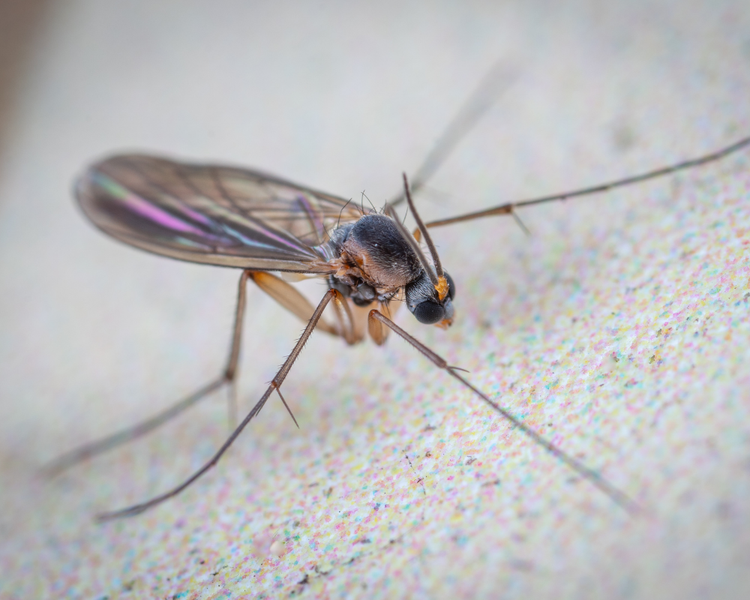
Quick answer: If the tiny dark flies in your house drift lazily around potted plants and run across the soil surface, they’re fungus gnats — not fruit flies. They breed in wet potting soil, not in food or drains. Let the top 3–5 cm of soil dry completely between waterings, add yellow sticky traps to catch the adults, and the population collapses in two to three weeks. If they keep coming back after the soil dries, you have a moisture source somewhere else in the building, and that’s a different problem.
The September houseplant handoff
Every year in late August and September, Ontario homeowners bring their plants back indoors. Ficus, monstera, herbs off the deck, the fern that summered on the porch. Within two or three weeks, a cloud of small dark flies appears in the living room — and almost everyone calls them fruit flies.
They usually aren’t. They’re fungus gnats, and they came inside in the pots.
The reason this matters is that every fruit fly remedy — the apple cider vinegar trap, the bleached drain, the sealed fruit bowl — does essentially nothing to a fungus gnat. People run those fixes for a month, get no result, and conclude they have an infestation that needs chemical treatment. What they actually have is overwatered soil.
The three-way ID: fungus gnats vs fruit flies vs drain flies
Get the ID right and the fix is obvious. Get it wrong and you’ll treat the wrong room for weeks.
Fungus gnats are about 2–4 mm, dark grey or black, slender, with long legs and long antennae — they look like miniature mosquitoes. They’re weak, drifting fliers. The tell is where they are: hovering around plant pots, running across the soil surface, or coming up when you water. They’re attracted to light, so you’ll often find them at windows and on screens.
Fruit flies are shorter and stockier, tan or brownish with red eyes, and they fly with purpose. They hang around the fruit bowl, the recycling bin, the bottom of the garbage, wine glasses and beer bottles. If a glass of cider on the counter fills up overnight, those are fruit flies.
Drain flies (or moth flies) look completely different once you look closely — fuzzy, moth-like, with rounded wings held roof-like over the body. They sit motionless on bathroom walls and tile, near floor drains, and they breed in the organic film inside slow drains. They barely fly; they hop.
Three insects, three completely separate breeding sites: wet soil, fermenting food, and drain slime. Our pest library has detailed profiles for the fruit fly and the drain fly if you want to confirm which one you’re looking at before you do anything else.
Why fungus gnats spike in Ontario in the fall
Three things stack up in September and October.
Plants come in. Any pot that summered outside brings its soil ecosystem with it, larvae included.
Watering habits don’t adjust. A plant on a sunny deck in July might need water twice a week. The same plant in a dim October living room, with shorter days and lower light, might need it every ten days. Most people keep the July schedule. The soil never dries, and permanently damp soil is precisely the fungus gnat’s breeding requirement — the larvae eat the fungi and decaying organic matter that thrive in it.
Heating season starts. Warm indoor temperatures let a generation complete in roughly three to four weeks, so a handful of larvae in a single pot becomes a visible cloud by mid-October.
The adults live about a week and do almost no damage — they don’t bite, they don’t carry disease into your kitchen, and they won’t harm your plants in normal numbers. They’re a nuisance and an indicator. The University of Minnesota Extension makes the same point: heavy larval populations can damage roots on seedlings and cuttings, but on established houseplants the adults are mostly an annoyance signalling too much water.
How to actually get rid of them
The whole method rests on one idea: you cannot win this by killing adults. The larvae in the soil are the population. Dry the soil and the population ends.
1. Let the top 3–5 cm dry out completely between waterings. Stick a finger in. If it’s damp at the second knuckle, don’t water. Fungus gnat eggs and young larvae die in dry soil. For most houseplants this alone breaks the cycle in two to three weeks. Do not skip this step and expect anything else on this list to work.
2. Water from the bottom where you can. Set the pot in a tray, let it drink, then pour off the excess after 20 minutes. This keeps the top layer — the breeding zone — dry while the roots still get what they need. Never leave a saucer with standing water in it.
3. Put out yellow sticky traps. Lay them flat on the soil surface or stake them just above it. Adults are strongly drawn to yellow. This won’t solve the problem, but it catches egg-laying females, gives you a visible count of whether you’re winning, and cuts the adult nuisance fast.
4. Top-dress with something inorganic. A 1–2 cm layer of horticultural sand, fine gravel or perlite on the soil surface creates a barrier females won’t lay through and dries out fast.
5. Repot the worst offender. If one pot is producing most of the flies, it’s often easier to repot it in fresh, well-draining mix, discard the old soil outside, and start clean. Penn State Extension notes that consistently overwatered pots and rich, poorly draining media are the single biggest driver — so change the media, not just the schedule.
6. Check for non-plant moisture. This is the step that separates a houseplant nuisance from a building problem. Fungus gnats will also breed in any chronically wet organic material: a leaking pipe under the sink feeding damp drywall, a crawlspace with standing water, a basement floor drain packed with debris, a condensate line, wet insulation behind a shower wall. If your soil is bone dry and the gnats keep coming, stop treating the plants — you have a moisture leak.
When it’s not the plants
Here’s the practical rule we give homeowners across Toronto and Mississauga: give the drying method three weeks. If the gnats are gone, you had a plant problem and you’ve solved it for free.
If the gnats persist after three weeks of genuinely dry soil — or if you’re seeing them in a room with no plants in it, or in a basement, or coming from a wall or floor — that’s a moisture and sanitation issue in the structure. That’s worth an inspection, because the flies are the cheap part. The wet drywall, the rotting subfloor, and whatever else is living in that damp are not.
Small-fly problems also have a habit of being mixed. It is extremely common for us to walk into a “fungus gnat” call and find fungus gnats in two pots, drain flies in a rarely used basement bathroom, and fruit flies in the recycling bin — three species, three sources, and a homeowner who has been fighting all three with one vinegar trap.
Our residential pest control inspection starts at $95, credited in full when you book the treatment. For small flies, most of that visit is finding the source — a moisture meter on suspect walls, drain checks, and a plant-by-plant look. That diagnosis is the whole job.
What treatment costs, and the case for not buying it twice
If treatment is warranted, General Insect Control runs from $395 exterior or $475 interior and exterior, with a 60-day guarantee. One-time service is the right entry point when there’s a single, identifiable source and it’s been fixed.
But small flies are a moisture story, and moisture is seasonal and recurring. Ontario houses swing from humid August to dry, heated January to damp April, and each of those transitions creates new conditions somewhere in the building. The homeowners who call us once a year about a different small fly in a different room are, almost without exception, the ones who bought the one-time treatment.
Our Insect Control plan is $845/year, and it’s the honest recommendation for a house with a history of recurring insect issues: scheduled seasonal visits, monitoring at the places where moisture problems start, and unlimited callbacks between visits at no extra cost. Two one-time treatments in a twelve-month span already cost more than the plan and leave you uncovered for the other ten months. If you want rodents included as well, Essentials at $1,195 covers both, and VIP starts at $1,395.
There’s no initiation fee, no setup fee, and no monthly billing — plans are annual, quoted up front.
Two minutes on our free quote quiz will tell us what you’re dealing with before we arrive, or call (705) 302-1887 to talk it through.
Frequently asked questions
Do fungus gnats bite? No. Fungus gnats have no biting mouthparts and don’t feed on blood. If something is biting you in a damp basement, it’s not a fungus gnat — that’s worth an inspection.
Will letting my plants dry out kill them? Most common houseplants tolerate the top few centimetres drying out far better than they tolerate constantly saturated soil. Root rot kills far more houseplants than underwatering does. Ferns, calatheas and a few other moisture-lovers need more care — for those, bottom-water and top-dress with sand instead of drying hard.
Are hydrogen peroxide or cinnamon soil drenches worth doing? They can knock down some larvae, but they don’t fix the condition that produced them. If the soil goes right back to being wet, the population rebuilds. Dry soil is the actual control; drenches are at best a supplement.
Why do I have gnats in a room with no plants? Either the adults have dispersed toward light from plants elsewhere in the house, or you have a second breeding site — a drain, a leak, or damp organic debris in a wall, crawlspace or basement. If the plants are dry and the gnats are still concentrated in one plantless room, look for water in that room.
Can one plant really cause the whole problem? Routinely. A single chronically overwatered pot can produce hundreds of adults over a few generations. This is why the top-dress-and-dry method works so well: it’s usually one or two pots doing all the breeding.
Sani IQ serves the GTA, York and Durham Region, Simcoe County, Barrie, Orillia and Muskoka. We’re BBB Accredited, carry $5M liability coverage, are licensed under the Ontario Pesticides Act and registered with the MECP, and hold a 5.0 rating across 126 Google reviews. Our technicians are employed, licensed and background-checked, and we use reduced-risk products wherever they’ll do the job.
⚡ NO PHONE CALL NEEDED
Know your exact price in 60 seconds3 quick questions — matched to the right treatment with real, published pricing. Instantly.
Take the Quiz📖 FREE EXPERT RESOURCE
Identify any Ontario pest69 free identification guides — photos, habits, risks and prevention. No sales pitch, just answers.
Browse the Pest Library🛟 HELP CENTRE
Before & after your visitPrep checklists, what to expect and aftercare — written by our technicians so your treatment works the first time.
Visit the Help CentreFix it today. Keep it fixed all year.
Protection plans from $845/yr — no contracts, no monthly billing
Four seasonal visits handle ants and wasps before summer and mice before the first frost, with free re-treatment if anything returns. Need it handled today instead? Same-day one-time service is always available.