
Do Cockroaches Come Out in Winter? Why Ontario Roach Problems Get Worse in the Cold
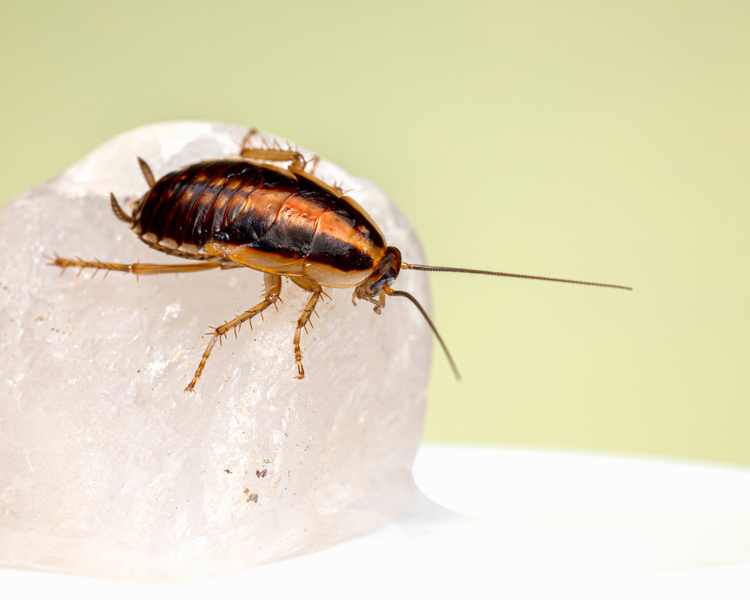
Quick answer: Yes — and in Ontario they are often worse in winter than in summer. German cockroaches, the species behind nearly every residential roach call we take, do not live outdoors here and do not “come in from the cold.” They already live inside heated buildings, where 20°C and constant humidity mean they breed year-round with no seasonal slowdown. What winter actually changes is concentration: heating season dries out the building, pushes roaches toward the few remaining moisture sources, and makes them far more visible. The population was there in August. You are just seeing it now.
Every year around late September the calls change character. Through the summer, roach reports trickle. Once the furnaces come on, they cluster — apartments, condos, semi-detached homes, restaurant kitchens. And almost every caller asks a version of the same question: do cockroaches come out in winter, or are these coming in from outside?
The honest answer reframes the whole problem, so it is worth getting right.
The species matters more than the season
Ontario has a handful of cockroach species, but the one in your kitchen is almost certainly the German cockroach. That distinction is not pedantry — it determines everything about how the problem behaves in the cold.
German cockroaches are what entomologists call an obligate indoor species. They cannot survive an Ontario winter outdoors. They cannot survive an Ontario autumn outdoors, in most cases. They do not have an outdoor population that migrates inside when the weather turns, because there is no outdoor population to migrate. NC State Extension’s summary of German cockroach biology and behaviour describes them as essentially entirely dependent on human structures throughout their range.
So when a roach appears in your Mississauga condo in January, it did not come in from the snow. It came from somewhere inside the building — your own unit, a neighbouring one, a shared wall, a garbage chute, or a bag you carried in.
That is a different problem than a seasonal invasion, and it needs a different response. Our Ontario cockroach field guide walks through telling the species apart, and the German cockroach identification page has the size, colour and egg-case markers if you want to confirm what you found.
How roaches actually arrive — the three routes
If they are not walking in from the yard, how do they get established?
They arrive in things you bring inside. Grocery bags, cardboard boxes, a case of pop from a warehouse, used appliances, secondhand furniture, luggage. A single fertilised female is enough to start a population. This is the most common route into a single-family home.
They move between units. In apartments, condos and townhome blocks, roaches travel along plumbing chases, shared wall voids, electrical conduit and drop ceilings. A unit that has never bought a suspect box can inherit a full infestation from two doors down. This is why single-unit treatments in multi-unit buildings so often fail — the population is building-wide, and the treated unit is simply re-colonised.
They ride in with deliveries in commercial settings. Restaurants, cafés, grocery and long-term care kitchens take in pallets and cardboard daily, and cardboard is close to an ideal cockroach habitat: corrugation for harbourage, glue for food, and it stays warm. This is the dominant route in the hospitality work we handle through our commercial pest elimination program.
Why heating season makes it worse, not better
Here is the part that surprises people. A heated Ontario building in February is a better cockroach habitat than the same building in July.
Temperature is held at the optimum. German cockroach development is fastest in the low-to-mid twenties Celsius — which is precisely where your thermostat sits from November to April. Outdoor pests slow down in winter. Indoor pests in a heated building do not slow down at all; if anything the building gets more consistently warm than it was during shoulder season.
Moisture becomes scarce, which concentrates them. Forced-air heating dries a building out. Cockroaches need water more urgently than food — they can go weeks without eating and only days without drinking. As the ambient humidity drops, the population migrates toward the remaining wet spots: under the sink, behind the dishwasher, around the toilet base, the bathroom vanity, condensation on cold-water pipes. Suddenly the roaches that were spread across the kitchen are stacked in four locations, and you start seeing them.
Harbourage tightens. Penn State Extension’s German cockroach guidance notes how heavily these insects favour warm, tight, dark harbourage near food and water — motor housings in appliances, the void behind a fridge, the gap under a cabinet toe-kick. Winter pushes them into exactly those spaces.
And nothing ever dies off. In an outdoor-driven pest problem, winter resets the population. Here there is no reset. The population you had in September compounds straight through to spring, with each female producing multiple egg cases and roughly 30 to 40 nymphs per case.
Why “I only see them at night” is not reassurance
Cockroaches are nocturnal and thigmotactic — they seek contact with surfaces on multiple sides of their body, which is why they wedge into cracks. A population that is comfortable stays hidden.
Seeing roaches in daylight, out in the open, or on vertical surfaces means the harbourage is full. Like the daytime-mouse problem, visibility is a capacity signal. By the time a roach walks across your counter with the lights on, the cracks behind your cabinets are already occupied.
The other thing worth knowing: for every roach you see, the hidden population is substantially larger. This is the point our guide German cockroach infestation: I see one cockroach covers in depth, and it is the single most useful correction to how most people size the problem.
The DIY mistake that makes winter roaches worse
Store-bought aerosol sprays are the most expensive thing you can do to a cockroach problem, and it is not close.
Contact sprays kill the roaches they hit and repel the ones they do not. Repelled roaches leave the treated harbourage and establish new ones — deeper in wall voids, further into appliance motors, and in multi-unit buildings, in the neighbouring suite. You convert one findable, treatable cluster into several hidden ones. Professionals call this scatter, and we routinely spend the first visit of a job undoing it.
Foggers and “bug bombs” are the same mechanism at larger scale, with the added problem that the aerosol never reaches the voids where the population actually lives.
The approach that works is the opposite: non-repellent materials and gel baits that roaches carry back into the harbourage, placed after an inspection identifies where the harbourage is. It is slower to look dramatic and considerably faster to actually finish.
What treatment costs and what we recommend
Every job starts with a $95 professional inspection, credited in full when you book the treatment. For cockroaches this matters more than for most pests, because the inspection is what tells us whether you have a contained unit problem or a building-wide one — and those are different jobs with different price tags.
- General Insect Control — from $395 exterior, or from $475 interior and exterior. Covers the treatment itself, with our 60-day guarantee on one-time services.
- Insect Control Plan — $845/year. This is the path we recommend for roaches specifically, and the reasoning is structural rather than commercial.
Cockroach control is not a single event. Egg cases are resistant to most treatment materials, which means a population always has a second wave waiting to hatch after the first knockdown. A one-time treatment handles the roaches present on the day. The annual plan is what carries you through the hatch cycles, monitors the harbourage points after they have been cleared, and — critically in apartments and condos — keeps coverage in place while neighbouring units remain a source of re-entry.
Put plainly: a one-time treatment is the entry point. The plan is what keeps you from paying for the entry point again in March. Full tier details are on our free quote quiz, which will scope your situation in about two minutes.
If you want the cost breakdown in more detail first, see what a cockroach exterminator costs in Toronto.
Where we see winter roach pressure concentrate
Across our service area the pattern is consistent: density and building age drive it more than latitude.
High-rise and mid-rise stock in Toronto produces the heaviest building-wide cases we handle, largely because shared infrastructure gives roaches unlimited internal travel. Markham townhome and condo blocks show the same pattern at smaller scale, often with a single source unit feeding four or five neighbours. In Mississauga, the mix of older rental stock and newer condo towers means we work both profiles in the same week.
Detached homes are not exempt — they just get there differently, almost always through something carried inside.
Frequently asked questions
Do cockroaches hibernate in winter? German cockroaches do not. In a heated building they breed continuously with no seasonal dormancy. Some outdoor species overwinter, but they are not the ones in Ontario kitchens.
Why am I suddenly seeing roaches in December when I saw none in summer? Because heating season dries the building and concentrates the population around the few remaining water sources, making a pre-existing population visible. The change is in where they are, not in how many arrived.
Can cold weather kill cockroaches in my house? Only at temperatures that would also destroy your plumbing. Turning the heat down is not a control method.
I live in a condo and my neighbour has roaches. Is treating my unit enough? Usually not on its own. We will treat your unit and tell you honestly if the building needs a coordinated response — and in a rental or condo, that is a conversation with property management, not something a single-unit treatment resolves.
Will they go away if I keep the kitchen spotless? Sanitation slows a population and makes baiting more effective, but German cockroaches survive on very little. Cleaning is a necessary part of the solution and is almost never the whole of it.
How quickly can you come out? Call (705) 302-1887. Cockroach calls get priority scheduling in heating season because the population compounds while you wait.
Sani IQ is licensed under the Ontario Pesticides Act and registered with the MECP, BBB Accredited, carries $5M liability coverage, and holds a 5.0 Google rating. Our technicians are employed, licensed and background-checked — never subcontracted. We use reduced-risk products and methods throughout.
⚡ NO PHONE CALL NEEDED
Know your exact price in 60 seconds3 quick questions — matched to the right treatment with real, published pricing. Instantly.
Take the Quiz📖 FREE EXPERT RESOURCE
Identify any Ontario pest69 free identification guides — photos, habits, risks and prevention. No sales pitch, just answers.
Browse the Pest Library🛟 HELP CENTRE
Before & after your visitPrep checklists, what to expect and aftercare — written by our technicians so your treatment works the first time.
Visit the Help CentreFix it today. Keep it fixed all year.
Protection plans from $845/yr — no contracts, no monthly billing
Four seasonal visits handle ants and wasps before summer and mice before the first frost, with free re-treatment if anything returns. Need it handled today instead? Same-day one-time service is always available.