
Overview
Carpenter bees are the exception among Ontario’s bees: the one species that genuinely damages your home. The eastern carpenter bee (Xylocopa virginica) reaches the northern edge of its range in southern Ontario, and every June homeowners from Oakville to Vaughan notice fat, shiny black bees hovering around eaves and deck railings — followed by a scatter of round, finger-width holes with yellow sawdust underneath. The bee itself is mostly bluster; the tunnels it drills are the real cost. On their own the holes look minor, but the same galleries get reused and extended year after year, and woodpeckers tear them wide open to reach the larvae. Left alone, a tidy row of holes becomes a fascia replacement.
Identification
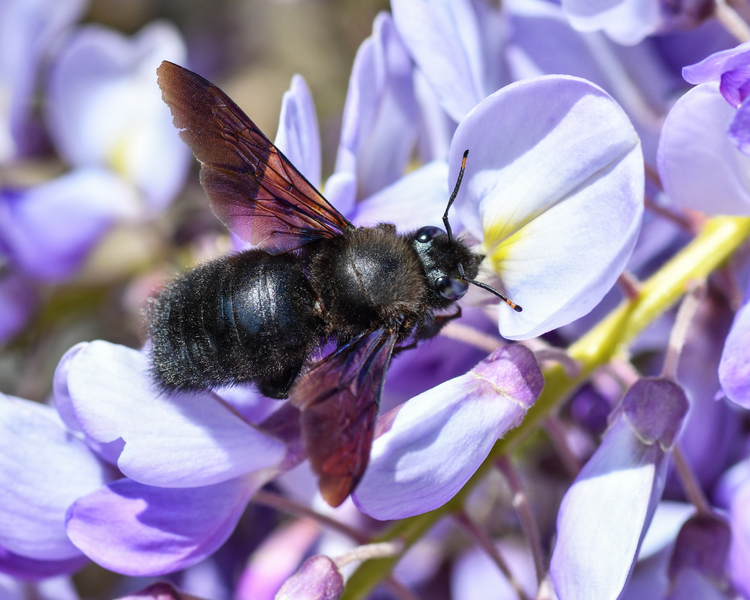
Carpenter bees are large — 20 to 25 mm — and easily mistaken for bumble bees at a glance. The decisive difference is the abdomen: a carpenter bee’s is glossy, black, and hairless, almost like polished plastic, while a bumble bee’s is fuzzy and yellow-banded. Males have a pale yellow or white spot on the face, and they’re the ones that aggressively dive-bomb anyone near the deck — all bluff, since males have no stinger at all.
| Feature | Carpenter Bee | Bumble Bee |
|---|---|---|
| Abdomen | Shiny black, hairless | Fuzzy, yellow-banded |
| Face | Male has pale spot | Solid, furry |
| Nesting | Round holes bored in wood | Ground burrows, cavities |
| Damages wood? | Yes | No |
| Near your deck | Hovers, guards a hole, dive-bombs | Passing through to flowers |
If the bee is hovering around wood, guarding a single round hole, or drilling, it’s a carpenter bee. If it’s working flowers and ignoring you, it’s a bumble bee — and harmless.
Life Cycle
Carpenter bees are solitary, not colonial. In spring an overwintered female selects a site and bores a round entrance hole straight into the wood, then turns 90 degrees to tunnel along the grain, creating a gallery roughly 15 cm long. She partitions it into cells, provisioning each with a ball of pollen and nectar and one egg. The larvae develop through summer, and a new generation of adults emerges in June — the peak of activity Ontario homeowners notice. These new adults overwinter in old galleries and re-emerge the following spring, which is exactly why the same boards are drilled again and again.
Habitat & Behaviour
Carpenter bees strongly prefer bare, weathered, untreated softwood — the cedar and pine used across Ontario for fascia, soffits, deck rails, pergola beams, fence posts, and the underside of boards. They largely ignore painted or stained surfaces, which is why a well-sealed home sees far less pressure. Males patrol the nesting area territorially, hovering and chasing off other insects and people, but they cannot sting; females do the drilling and are docile unless handled. Activity is concentrated where there’s exposed, sun-weathered softwood at roof or deck height.
Diet
Adult carpenter bees feed on nectar and pollen and are legitimate pollinators — they don’t eat the wood they bore (unlike termites, they excavate it and discard it as sawdust). The pollen and nectar they collect goes to provision the brood cells inside the gallery, one loaf per egg, to feed the larvae through their development.
Signs of Infestation
- Round holes about 1 cm across (roughly finger-width) drilled into fascia, soffits, deck rails, or fence posts — the signature sign.
- A fan of coarse yellow sawdust below each hole, often with yellow staining on the wood beneath.
- Large black bees hovering and dive-bombing around eaves and railings, especially in June.
- Ragged, torn-open holes where woodpeckers have enlarged galleries hunting larvae — a sign of an established, reused site.
- Multiple holes in one board, indicating the wood is already being reused across generations.
Damage Caused
A single gallery is minor, but carpenter bee damage is cumulative. Females re-enter and extend existing tunnels year after year and branch new tunnels off old ones, so a board that had one hole can become honeycombed internally over several seasons. The bigger accelerant is woodpeckers: they hear the larvae and rip the galleries open, turning a neat 1 cm hole into a ragged gash that admits water and starts rot. The bee is the nuisance; the secondary woodpecker and moisture damage is what drives a fascia or trim replacement.
Health Risks
Carpenter bees are a low medical risk. The dive-bombing males near your deck have no stinger and are pure bluff. Females can sting but do so only if grabbed or trapped. There’s no colony to provoke into a mass defensive response the way there is with honey bees or wasps. The genuine hazard is practical rather than venomous: reaching second-storey fascia and soffits means working off a tall ladder around flying insects, which is a real fall risk and a common reason homeowners book the job rather than DIY it.
Seasonal Activity in Ontario
Adults become active in April as the weather warms, and the year’s key event is the emergence of new adults in June, when drilling and nesting peak across southern Ontario. Activity continues through summer as larvae develop, tapering off by September. Late June into July is the ideal inspection window: check fascia, soffits, deck rails, pergola beams, and fence posts for fresh holes and sawdust while the bees are still active and treatment can reach the current generation before it overwinters and returns.
Where They Hide
Look at any bare, sun-weathered softwood at height: fascia boards and soffits, the top and underside of deck rails and joists, pergola and arbour beams, exposed rafter tails, wooden porch ceilings, fence posts and rails, and the rough-cut ends of deck and pergola boards. South- and west-facing wood that weathers fastest tends to take the most drilling.
How They Enter Homes
Carpenter bees don’t enter living space — they nest in the exterior wood itself. A female simply lands on an attractive board and bores in. “Entry” prevention is therefore about the wood surface: bare, unfinished, weathered softwood invites drilling, while painted and sealed wood is far less attractive. Exposed rough-cut board ends are prime first targets.
Prevention Tips
- Walk your exterior in June, checking fascia, soffits, deck rails, pergola beams, and fence posts for new holes and sawdust.
- Paint or stain bare softwood — a sealed, finished surface is the single best deterrent.
- Cap or seal rough-cut deck and pergola board ends, which are prime drill sites.
- Fill and repaint any existing holes — but only after treatment confirms the gallery is empty.
- Don’t seal active holes; a trapped bee chews a fresh exit and makes things worse.
- Book an inspection if you see more than a couple of holes, since multiple galleries mean the wood is already being reused.
DIY vs. Professional Treatment
DIY is possible but it’s a time-and-risk trade, not a quick fix. It means dusting each gallery with insecticide, leaving the holes open for a few days so returning bees track the product, then plugging and painting every hole — and repeating as new bees appear through the season, often from a ladder around stinging females. Seal a hole too early and you simply force a new one. Professional residential pest control handles the galleries in one visit, covers the returns, and removes the ladder risk. Sani IQ quotes carpenter bee work under exterior insect treatment, generally starting from $395, and backs it with our Pest-Free-Or-It’s-Free guarantee; recurring properties are usually cheaper on the annual Insect Control plan. For the full numbers, see our 2026 carpenter bee removal cost guide.
References
- Penn State Extension — The Eastern Carpenter Bee
- Government of Ontario — Using Pesticides in Ontario
Last updated: July 16, 2026 · Reviewed by Sani IQ licensed technicians