
Larder Beetles in Your House? Here's What They're Feeding On
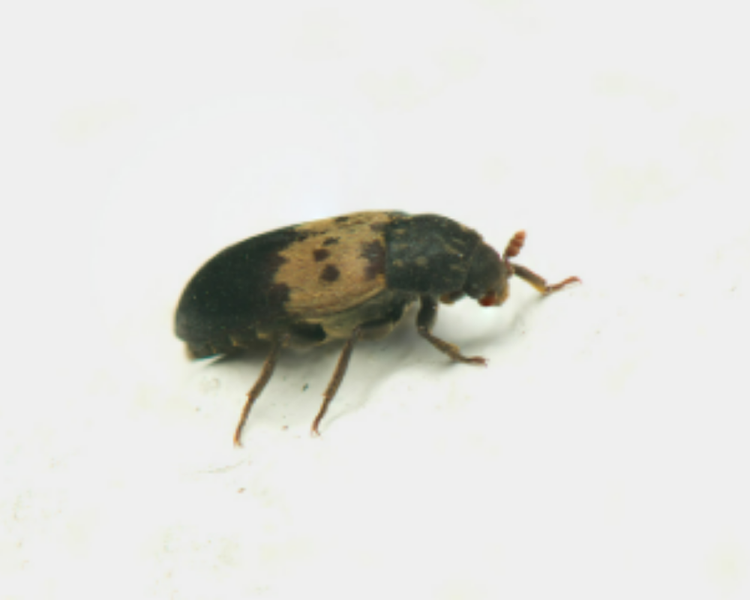
Quick answer: Larder beetles are not after your carpets, your closet or your flour — they are after animal protein. If they are breeding inside your house, there is a protein source somewhere in the structure: most often a dead mouse in a wall void, an abandoned bird or rodent nest, a layer of dead cluster flies or lady beetles in an attic, or an open bag of dry pet food or birdseed. Spraying the beetles you can see will not end it while that source is in place. Find the source, remove it, and the beetles stop.
Most homeowners meet this pest as a fat, hairy, striped grub in a window well or along a basement baseboard, and the first instinct is a spray can. That instinct is why larder beetles are one of the most-repeated calls we take. The beetles you find crawling are the end of the story, not the beginning: somewhere behind the drywall, above the ceiling or inside a forgotten bag, something is feeding them.
What a larder beetle actually looks like
The larder beetle (Dermestes lardarius) is a dermestid. Adults run about 8 mm — bigger than most beetles people find indoors — with a dark brownish-black head, thorax and lower wing covers. The giveaway is the upper half of the wing covers: a light brown or yellowish band carrying several darker spots on each side. The black larder beetle (Dermestes ater) is a close relative, uniformly dark with no band.
The larvae are what people usually find and almost never recognize. A mature larva reaches about 13 mm, is covered in long bristly hairs, often looks striped with alternating dark and light bands across the back, and carries two stout, curving spines at the tip of the abdomen. A hairy, banded, spiny grub about half an inch long in a window well, attic or baseboard is very likely a larder beetle larva.
That matters because the larvae are the ones feeding and doing the damage. The adults walking across your floor are travelling — between the source, a mate, and a place to lay eggs.
Larder beetle or carpet beetle? The answer tells you where to look
These two get mixed up constantly, and the mix-up sends people hunting in the wrong room.
Carpet beetles are small — roughly 2 to 4 mm — rounded and often mottled black, brown and cream. Their larvae feed on keratin: wool, silk, feathers, pet hair and the lint under baseboards. The source is usually fabric or stored textiles. Details on our carpet beetle library page.
Larder beetles are two to three times bigger, more elongate, and carry that pale banded shoulder. Their larvae want concentrated animal protein, not fibre. A wool sweater does not interest them. A dead mouse does.
So: small, round, in the carpet? Read up on carpet beetles. Eight millimetres with a banded shoulder, turning up repeatedly? You are looking for a carcass. Our beetle library covers the other species found here.
The source rule: the adults are a symptom, the protein is the problem
This is the most useful thing to understand about larder beetles. They do not wander in from the garden and settle down — they establish where there is food. Virginia Tech Cooperative Extension’s publication on the species lists the diet plainly: skins, bones, hides, feathers, hair, taxidermy mounts, cured meats, cheeses, dry pet food, leather or wool soiled with food or body oils, material from bird, rodent and wasp nests, and dead insects.
In Ontario houses, these are the sources we actually find, roughly in order of frequency:
1. A dead rodent in a void. A mouse that dies inside a wall cavity, under a floor, above a drop ceiling or in attic insulation is a perfect, undisturbed protein supply. This is why larder beetle season follows mouse season: mice move in through the fall, some die indoors over the winter — particularly where bait has been used in a void — and by midwinter the beetles are breeding on the remains.
2. The fall insect graveyard. Specific to our climate, and almost nobody explains it locally. Cluster flies, Asian lady beetles and stink bugs overwinter by the thousand in Ontario attics, soffits and wall voids, and many die there. That accumulation is exactly what larder beetles breed in — the Virginia Tech list names those three insects directly. In our experience it is at least as common a source here as a rodent carcass, and it gets missed because nobody thinks of last year’s fly cluster as a food supply.
3. An abandoned nest. Bird nests in soffits, vents and dryer outlets; old wasp nests in wall voids; squirrel nests in insulation. Nest material is feathers, fur, dead brood and shed skin. An empty nest is still a larder.
4. Stored protein. An open or torn bag of dry pet food or a bin of birdseed will support a population on its own. So will mounted trophies, feather decor, hides, home-cured meat, or wool soiled with food or body oils — uncommon in a suburban house, common at cottages and rural properties.
Why spraying does nothing useful
A perimeter or baseboard spray kills adult beetles that walk across it. It does not reach the larvae, because the larvae are inside the source — buried in insulation under a carcass, down in nest material, inside the bag.
There is a second reason. When mature larvae are ready to pupate they dig chambers in the food source or in nearby wood or plaster, boring into the structure — which is also the only real property damage this insect causes. A pupa inside a joist is past any surface residual.
So the pattern is predictable: a quiet week or two, then another wave. In a heated house larder beetles run several generations a year, and each wave is the same source producing again. The product did not fail. The diagnosis did.
Recurring larder beetles are telling you about rodents
Here is the part worth acting on. A carcass in a wall is not an accident — it is evidence. A mouse got into that cavity through an entry point, and that entry point is still open.
Which is why treating this as a beetle job alone buys a season at most. The sequence that ends it: remove the protein source, then find and seal the openings that let the animal in. Our mice control work in Scarborough and across the GTA is built around that second half, because exclusion is the only part of rodent control that lasts. If you are not sure whether you have active rodents alongside the beetles, our guide on whether you need an exterminator for mice covers the signs honestly, including when you can handle it yourself.
Where these show up across our service area
The pattern varies by housing stock. In Newmarket and older York Region homes it is open soffits and vented attics — a nest in a soffit return, or heavy cluster-fly accumulation along the eaves, producing beetles that appear at upstairs windows in late winter. Around Whitby and through Durham it skews to rodent carcasses in voids where bait went down before the entry points were sealed. In Etobicoke, post-war framing and unsealed service penetrations give mice and the beetles that follow them long undisturbed runs inside the walls. In Innisfil and the rural 705 it is usually an outbuilding — stored birdseed, feed bags, a barn — with the beetles moving from there into the house.
How to find the source yourself
Before you call anyone, this is worth an hour.
Map the sightings. Larvae travel away from the source, so density tells you something. Note where and when you find them — a cluster at one upstairs window and nothing elsewhere points above that ceiling.
Use your nose. A rodent carcass is detectable for two to four weeks. Work toward any odour: warmest wall, exterior-facing cavity, near plumbing runs.
Check the attic properly — along the eaves and in the insulation, not just from the hatch — for accumulated dead flies and lady beetles, nest material and droppings. Then check soffits, vents and the dryer outlet from outside, and open every bag of dry pet food, birdseed or feed.
Vacuum, date it, and re-check in seven days. This is the test that settles it. No new larvae means a finished source playing itself out. New larvae means the source is still live and producing — time to stop guessing.
When it is time to bring someone in
Call when you cannot locate the source, when the evidence points inside a wall or ceiling you would have to open, or when the beetles have returned across more than one season.
An inspection here has two jobs in one visit: find what the larvae are feeding on, and find how the animal that became their food got in. We work the voids, attic, soffit line and stored-food points, then map the rodent entry points that created the problem. The inspection is credited in full when you book the treatment.
Treat the one-time cleanup as the entry point, not the finish line. A one-time service removes the source and the current generation, which solves what you can see. What stops it repeating is the year-round protection plan: scheduled exterior work through the seasons, exclusion maintained rather than done once, and attic and void checks that catch the next dead mouse or fly accumulation before it becomes a beetle population. One infestation that gets as far as boring into joists costs more to put right than a year of protection. Compare the year-round protection plans, take the free quote quiz, or see how scheduled visits work on our residential pest control page.
Sani IQ is BBB Accredited, carries $5M liability coverage, holds a 5.0 Google rating, and is licensed under the Ontario Pesticides Act and registered with the MECP. Our technicians are employed, licensed and background-checked — never subcontracted. Reduced-risk products; 60-day guarantee on one-time services. Call (705) 302-1887.
Frequently asked questions
Are larder beetles dangerous? They do not bite, sting or transmit disease. The costs are contamination of stored food and the boring larvae do into wood to pupate. The bigger risk is indirect: a population usually means a rodent or wildlife issue nobody has addressed.
Why am I getting beetles in the middle of winter? Because your house is heated. Outdoors they are seasonal; indoors, with a steady food source and room temperature, they run several generations a year. Midwinter is their most common appearance in Ontario homes — which is why it usually traces back to something that died over the fall.
Will they go away on their own, and how long does it take? Only when the food is gone. A finished source — a single mouse, a bag you threw out — plays itself out over two to four weeks as the last larvae develop and the adults die off. A continuing source, like an active nest or an attic that collects dead insects every fall, will not. Judge it by whether new larvae appear; if they do after a month, there is a second source.
⚡ NO PHONE CALL NEEDED
Know your exact price in 60 seconds3 quick questions — matched to the right treatment with real, published pricing. Instantly.
Take the Quiz📖 FREE EXPERT RESOURCE
Identify any Ontario pest69 free identification guides — photos, habits, risks and prevention. No sales pitch, just answers.
Browse the Pest Library🛟 HELP CENTRE
Before & after your visitPrep checklists, what to expect and aftercare — written by our technicians so your treatment works the first time.
Visit the Help CentreFix it today. Keep it fixed all year.
Mice? The Sani IQ Rodent Program: $445 at the first visit, then $150 a quarter, 12-month warranty. Bugs too? Protect from $249 a visit.
Every visit is billed after it's done — no monthly fees. Free re-service if anything returns between visits, a photo report every time, and the stations stay in all year on the Rodent Program.