
Tiny Fuzzy Flies in Your Bathroom? They're Breeding in the Drain, Not Flying In
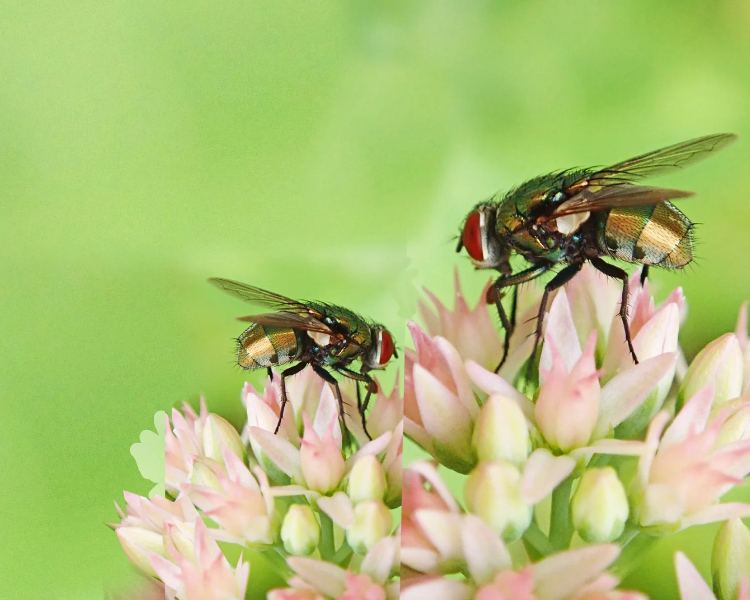
Quick answer: Small, fuzzy, moth-like flies resting on the wall near a sink, tub, shower or basement floor drain are almost certainly drain flies, and they are not getting in from outside — they are hatching a few inches away, inside the pipe. Their larvae live in the gelatinous film that builds up on the inner wall of a drain and its trap, so the fix is mechanical: physically take that film off the pipe wall with a brush. Pouring something down the drain, fogging the room or hanging a trap kills adults that are replaced within days. Find the drain, scour the pipe, and the flies stop. If you scour every drain and they keep coming, the breeding site is behind a surface — and at that point you are looking for a plumbing defect, not an insect.
A fly in your house in November is an indoor fly
By mid-November in Ontario there is nothing flying outdoors. If a small fly is circling your bathroom while the furnace runs and the windows have been shut for six weeks, it did not come in through the door. It completed its whole life cycle inside your house — which means there is standing organic material in your house for it to do that in.
That is the entire diagnostic. A drain fly is not a mystery — it is a pointer, sitting within a few feet of the thing that produced it, because drain flies barely fly. Iowa State University Extension says that in homes they “usually originate in sink, bathtub, shower, or floor drains, especially drains that are seldom-used or slow-running,” and UC’s Integrated Pest Management program notes that adults “can often be found very near to their development site.”
“Seldom-used” is what makes this a late-autumn problem in a particular kind of house. In the older Oakville and Burlington lakeshore stock we work in — and in any home with a finished basement — there is usually a fixture nobody touches between Labour Day and Christmas: the lower-level guest bathroom, the laundry tub behind the washer, the basement floor drain, the wet bar sink. Through summer they get occasional use and the occasional flush. Through autumn they sit, the film thickens, and the first cold snap is when someone finally notices the flies — not because the flies arrived, but because everyone is indoors looking at the walls. What we cover across Halton is on our Oakville pest control page, and the general approach on our residential pest control page.
There is a second November candidate homeowners never check. The University of Maryland Extension lists breeding sites beyond drains, including “condensate pans under refrigerators and air conditioners.” Your air conditioner shut down weeks ago. Its pan and line have been sitting with whatever was in them ever since.
Make sure it is actually a drain fly
Three different small flies get called “those little flies in the bathroom,” and they need three different responses.
Drain flies are fuzzy — Iowa State attributes the look to “a dense covering of long hairs on the body and wings,” which is where the alternative name moth fly comes from. They hold their wings roof-like over the body at rest, they are dark, and they sit still on a wall or fixture rather than circling. How small depends on who you ask: Ohio State University Extension puts adults at one-fifth to one-sixth of an inch, UC IPM at about one-eighth, Maryland at one-sixteenth to one-quarter. The silhouette is what matters: tiny, hairy and moth-shaped.
Fruit flies are not fuzzy. They are smooth, tan to brown, often red-eyed, and they hover around fruit bowls, recycling and the bottom of a garbage can rather than around plumbing. If the flies are worst in the kitchen, start there instead.
Cluster flies are much bigger, slow and clumsy, and collect on the inside of windows on a sunny winter afternoon, usually upstairs. They come from wall voids and the attic, not from a pipe — a building-envelope problem, not a drain.
Our drain fly page in the pest library has identification photos if you want to compare.
One reassurance while you look: they do not bite. UC IPM states that “Moth flies do not bite people or animals”; Iowa State, that “They do not bite or sting.” On disease, Iowa State’s position is that while they “could possibly be vectors of disease pathogens because of their points of origin, there is no evidence of actual transmission.” Ohio State notes one real effect in heavy, long-running infestations: “Bronchial asthma can be caused by inhaling fragments and dust of dead flies” — a reason to clear them properly, not a reason to worry.
Where the film actually is
The larvae are not swimming in the water in your trap. They are in the slime on the pipe wall — the few inches you can reach, and the few past it that you cannot. Iowa State is direct: “The small fly larvae develop in and feed on the gelatinous film (slime) that can build up inside drains.” Maryland adds what is in that film — they “feed on algae, bacteria, and fungi in the slime” — and places it precisely: “The larvae live in the gelatinous film or slime in drains and traps.”
The candidate list, in the order we find them in a house:
- The bathroom sink’s tailpiece and P-trap, especially a sink that collects toothpaste, soap and hair.
- A shower or tub drain, under the strainer, where hair and soap scum build a mat.
- The basement floor drain — the single most overlooked fixture in an Ontario house.
- The laundry tub and the standpipe behind the washer. Ohio State’s inspection list includes a detail worth copying: “Look for wet lint under the washing machine.”
- An air conditioner or refrigerator condensate pan (Maryland).
- Beyond drains, Maryland lists “dirty garbage cans, saucers under potted plants, clogged storm drains,” and Iowa State adds “under dripping pipes and refrigeration equipment.”
The overnight test that names the drain
In a house with two bathrooms and a basement you always have more than one suspect, so do not guess.
Iowa State’s test: “cover the drain with a plastic film taped to the floor or fixture.” If that drain is the source, the flies “will accumulate underneath the film within a day or two.” UC IPM’s is a sticky version: “Coat the inside of a cup or jar with Vaseline or vegetable oil and then invert the cup to cover the drain opening,” left “in place for 24 hours.” Ohio State suggests the same principle using glue boards taped inside a clear container over the opening.
Do every candidate on the same night, label them, and read them in the morning. The drain with flies stuck to it is your drain; the clean ones are off your list for good. Tape all four edges — a seal that is not a seal tells you nothing — and leave the fixtures unused overnight.
What actually clears them
All four sources land in the same place, and it is not a product. Iowa State says it as plainly as it can be said: “The only effective method to eliminate drain flies developing in drains is to clean the inside of the drain pipe to eliminate the organic matter.”
- Scour the pipe wall mechanically. Iowa State: “Clean slow-moving drains with a stiff brush or other tool.” Ohio State specifies “a good, stiff, long-handled brush.” UC IPM says to “use a hard bristle brush with an industrial drain cleaner.” The brush is the active ingredient — you are taking the film off the wall, not dissolving it.
- Pull the trap if you can reach it. On a sink with an accessible J-trap, UC IPM’s instruction is to remove the trap and clear the debris out of it. That takes out the most reliable breeding chamber in the fixture in one step.
- Flush afterwards. Maryland: “Clean traps and drains mechanically or with an over-the-counter drain cleaner followed by hot water.”
- For a drain you cannot brush, Iowa State offers the alternative: it “can be rinsed with water under high pressure or ‘sterilized’ by slowly pouring boiling water down along the sides of the drain pipe.” Slowly, and along the sides — the point is contact time against the pipe wall, not volume.
- Then keep it from rebuilding. Ohio State recommends “an enzyme-action product that is designed to break the sticky bond”; UC IPM, that “regular use of an enzymatic drain cleaner may help to prevent the organic buildup.” Biological products are maintenance, not a cure.
Expect a short tail. Adults already on the wing live on regardless of what you do to the pipe — Maryland says they “may live up to 2 weeks,” Ohio State “about two weeks.” Judge your work by whether new flies keep appearing after that, not by whether the room is empty tomorrow.
Why the popular fixes fail
Bleach. Ohio State: “The use of bleach does not seem to rid pipes of the scum, and the drain fly larvae are surprisingly resistant to bleach.” Iowa State: “There is no benefit to treating drains with bleach or ammonia.” It runs past the film without taking it off the wall.
Boiling water on its own. Here the sources disagree, and you deserve both sides. UC IPM names it as a myth: “A common misconception is that pouring boiling water and/or bleach down a drain will control these flies,” because “these treatments do not remove the organic film within the drain; and they provide at best short-term control of flies.” Iowa State recommends slow boiling water specifically as the fallback for a drain that cannot be scrubbed. The two reconcile: everyone agrees the film has to come off, and they differ on whether hot water alone takes it off. What we do on a job is treat boiling water as a finishing flush after the brush, never as the method.
Never mix drain products. Ohio State warns that caustic cleaners “are not as effective as other means and must never be followed with bleach since chlorine gas can be released.”
Sprays, foggers and bug bombs. Ohio State on aerosols: “these are only effective in knocking down active insects,” and they “will not kill the larvae and new flies will soon appear.” Total-release foggers “will only kill flying adults and they leave no residues.”
Pouring insecticide down the drain. Ohio State: “There are no insecticides registered for use in drains or sewage systems, so do not simply pour an insecticide down a drain.” A licensed Ontario applicator uses a product according to its registered label, and a drain is not on that label.
Sticky and UV light traps. Ohio State: they “can capture some of the flies, but will not eliminate an infestation.”
UC IPM sums up the logic in a sentence worth taping to the bathroom mirror: “Chemical control is generally considered unnecessary for moth fly management, as control will only be temporary unless larval development sites are located and removed.”
When the drain is not the answer
This is the part worth knowing about.
If you have tested and scoured every reachable drain, trap, condensate pan and standpipe and new flies are still emerging, the breeding site is behind a surface. UC IPM is explicit: moth flies “have been found developing in elevator pits, around sump pumps, and in material beneath leaking drain and sewage pipes,” and “Pipes in crawlspaces, wall voids, and the underside of concrete slabs may need to be inspected for breaks or leaks if developing moth flies are not found in drains or other exposed locations.” Maryland separately lists “areas of sewer leaks and back-ups” and “clogged storm drains” among breeding areas.
Read that plainly: a drain fly population you cannot find is evidence of wet organic material somewhere that should be dry. A cracked drain line under a basement slab. A failed joint in a wall void. A sump pit running as a settling tank. Those are building problems with costs attached that have nothing to do with insects, and the flies are the cheapest early warning you will get for them.
So the order matters. Do the drains first, properly, because that is the answer in most houses. If they come back clean and the flies keep coming, stop buying products and start looking for water. UC IPM’s advice at that point is that where development sites are hidden, “a professional pest control service should be contacted for advice” — and the call after ours is usually to a plumber.
What a visit from us looks like on this
We treat a drain fly call as an inspection problem, because that is what it is. The technician works the house fixture by fixture, sets the overnight tests where more than one drain is in play, identifies the breeding site rather than guessing at it, and tells you plainly whether you are looking at twenty minutes of mechanical cleaning you can do yourself or a structural problem that needs a different trade. If it is the former, we will say so.
The year-round program earns its place on houses where this is not the only thing going on — the finished basement that also has centipedes and the occasional mouse, the older home where several small problems trace back to one moisture source. It treats on the first visit, verifies at about three weeks, seals entry points once the verification is done, carries a twelve-month warranty, has no monthly fees, and is billed after each visit. For what any of it costs, see plans and pricing; to describe what you are seeing and get a straight answer, the free quote quiz takes two minutes. Or call us at (705) 302-1887.
Our technicians are employed by us, licensed under the Ontario Pesticides Act and background-checked; we are registered with the Ministry of the Environment, Conservation and Parks and accredited by the Better Business Bureau. We work with reduced-risk products and, on this problem, usually with a brush. The inspection fee is credited in full when you book the treatment.
Frequently asked questions
Where are drain flies coming from if all my windows are closed? From inside the house. The whole life cycle happens in the film inside a drain, trap, condensate pan or other constantly wet organic deposit, so a closed house is no obstacle. Ohio State does note two outside routes worth knowing in other seasons — wind can carry them from sewage treatment facilities “to nearby homes up to a mile away,” and “Some species have adults that are small enough to pass through ordinary window screening” — but in an Ontario November neither explains flies in your bathroom.
How fast can they rebuild after I clean the drain? Fast enough that you have to finish the job. Ohio State puts egg hatch at 32 to 48 hours at 70°F and larval development at 9 to 15 days, with a complete cycle “in one to three weeks.” UC IPM gives 8 to 24 days depending on temperature; Maryland, 7 to 28 days. A heated house in winter sits at the warm end of all three, so a half-cleaned drain will be producing flies again inside a month.
I only see them in the evening. Is that normal? Yes. Ohio State describes adults as most active in the evening, resting “in shaded areas or on walls near plumbing fixtures” otherwise, and flying in “irregular, hesitating flights covering only a few feet in short, jerky lines.” That weak, hopping flight is a useful identification clue and a useful locating one — follow where they land, not where they fly.
Can I just stop using that bathroom until they go away? It usually makes it worse. Seldom-used and slow-running drains are exactly where Iowa State says they originate, because stagnation is what lets the film thicken. Running water through a drain is not a treatment, but abandoning one is an invitation.
Is a drain fly problem a sign my house is dirty? No. That film forms on the inside of pipe walls in every house in the province and cannot be cleaned from the outside. Whether it reaches fly-supporting thickness is mostly a function of how often the fixture is used and how well it drains.
Do I need pest control for this, or a plumber? Start with the pest side, because in most houses the answer is a drain you can identify and clean. Call a plumber when the drains test clean and the flies persist, when a fixture is slow as well as fly-producing, or when the flies trace to a floor drain or a wall void rather than to a fixture you can open — those point at a break or a leak rather than at ordinary buildup.
SERVICE IN YOUR AREA
Dealing with this right now? Residential pest control · Pest control in Burlington
⚡ NO PHONE CALL NEEDED
Know your exact price in 60 seconds3 quick questions — matched to the right treatment with real, published pricing. Instantly.
Take the Quiz📖 FREE EXPERT RESOURCE
Identify any Ontario pest69 free identification guides — photos, habits, risks and prevention. No sales pitch, just answers.
Browse the Pest Library🛟 HELP CENTRE
Before & after your visitPrep checklists, what to expect and aftercare — written by our technicians so your treatment works the first time.
Visit the Help CentreFix it today. Keep it fixed all year.
Mice? The Sani IQ Rodent Program: $445 at the first visit, then $150 a quarter, 12-month warranty. Bugs too? Protect from $249 a visit.
Every visit is billed after it's done — no monthly fees. Free re-service if anything returns between visits, a photo report every time, and the stations stay in all year on the Rodent Program.