
Overview
Most of the moths Ontario homeowners notice — the big ones battering a porch light on a July night — never come indoors to breed. Only two kinds establish inside a house, and they live in completely different rooms. Pantry moths infest the kitchen, breeding inside stored dry food. Clothes moths infest the closet, feeding on wool, fur, and other animal fibres. Telling them apart is the first step, because the fixes share nothing: one is a pantry clean-out, the other is a laundering-and-storage job. Both announce themselves the same way — a small moth fluttering where it shouldn’t be — but a moth near the flour and a moth near the sweaters are two separate problems.
How to Tell Ontario’s Moths Apart
The room you find them in tells you almost everything, but appearance and evidence confirm it. Use this table, then read the full profile for the moth you’re dealing with.
| Feature | Pantry Moth | Clothes Moth |
|---|---|---|
| Where you find it | Kitchen, cupboards, near stored food | Closets, drawers, dark undisturbed storage |
| Adult size | 8–10 mm; ~16 mm wingspan | 6–8 mm; small and slender |
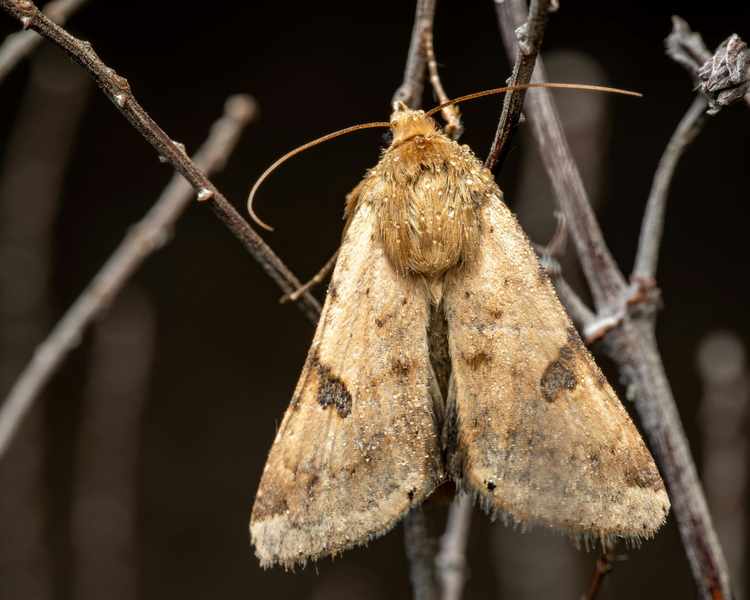
| Adult colour | Two-tone: pale grey base, coppery-bronze wing tips | Uniform buff-gold; webbing moth has a reddish head tuft |
| Flight | Zig-zags openly around the room | Weak, avoids light; scuttles rather than flies |
| What it damages | Flour, grains, cereal, nuts, dried fruit, pet food | Wool, silk, fur, feathers, felt, leather |
| Tell-tale sign | Webbing and clumping in dry goods | Threadbare patches, silken tubes, holes in wool |
The flight behaviour is the quickest field test. Pantry moths fly in open, erratic zig-zags across the kitchen; clothes moths are reluctant fliers that prefer to run into a dark corner when disturbed.
Damage & Health Risks at a Glance
Neither moth poses a health risk — they don’t bite, sting, or transmit disease, and swallowing a few larvae with contaminated food isn’t dangerous. The damage is economic. Pantry moths spoil dry food with silk webbing, shed skins, and frass, and a single overlooked package can seed an entire cupboard within weeks. Clothes moth larvae chew irregular holes and threadbare patches in wool coats, sweaters, rugs, and upholstery, and because they favour dark, undisturbed storage, the damage is often discovered only when a seasonal item comes back out. For restaurants and food-handling businesses, pantry moths carry a compliance dimension as well, since contaminated stock fails health inspection.
Seasonal Pattern in Ontario
Pantry moths peak in the summer. Ontario’s warm months shorten the egg-to-adult cycle and let generations overlap, so a small spring problem can become a cupboard full of moths by late June. Clothes moths are less seasonal — heated Ontario homes give them warmth year-round — but activity often surfaces in spring and fall, when wool clothing gets packed away or pulled back out and any hidden damage becomes visible. In both cases, indoor heating means neither pest truly goes dormant the way outdoor insects do.
When to Call a Professional
A first, contained moth problem is usually a do-it-yourself job: find the source, remove it, deep-clean, and monitor with pheromone traps. Call a professional when moths keep reappearing weeks after a thorough clean-out, when you can’t locate the source, or when the infestation has spread beyond one cupboard or closet. Persistent returns mean a breeding source is still hidden, and a trained inspection finds what a homeowner sweep misses. Sani IQ’s residential pest control service starts with locating that source rather than spraying and hoping.
References
- National Pesticide Information Center — Pantry Pests
- University of Kentucky Entomology — Clothes Moths
- UC IPM — Clothes Moths
Last updated: July 16, 2026 · Reviewed by Sani IQ licensed technicians