
Closing the Cottage? The Pest-Proofing Checklist for Muskoka, Orillia & Simcoe County
Quick answer: The pest damage that ruins a cottage happens in the eight months nobody is there. Three species do almost all of it in Muskoka, Orillia and Simcoe County: mice chewing and nesting, cluster flies pouring into sun-facing walls in late August and September, and carpenter ants quietly tunnelling through damp framing. Every one of them is stopped by sealing and treating before you close up — not by traps left behind on the counter. Book your close-up pest visit for late August or early September, before the first cold snap pushes everything indoors. Questions? Call (705) 302-1887.
It is August 1. You have maybe six good weekends left, and somewhere on the back of an envelope there is a list: shut off the water, drain the lines, pull the dock, bring in the cushions.
Pest-proofing almost never makes that list. It should be near the top of it, because it is the one item where skipping it compounds. A mouse population that moves in on Thanksgiving weekend and breeds until May is a bad spring, a bad smell, chewed wiring, contaminated insulation, and a cleanup bill that dwarfs what an exclusion visit would have cost.
We service cottages across Muskoka, Orillia, Innisfil and the Barrie area, and the calls we get in May are almost entirely preventable with work done in September. Here is the checklist.
Why an empty cottage is a better target than an occupied house
A year-round house has three things working against pests: constant traffic, even heat, and someone who notices the first mouse dropping on the counter. A closed cottage has none of that. It goes quiet in October, and the framing cavities become the most sheltered structure for a hundred metres in any direction. A pair of mice that gets in on October 12 has until your first May visit to do whatever it wants.
Cottage-country construction makes it easier still. Older Muskoka and Lake Simcoe cottages tend to have post-and-pier or crawlspace foundations with gaps at the sill, board-and-batten walls with real seams, and additions built onto additions with imperfect joints. Newer builds are tighter but share the same weak points: unsealed utility penetrations, a worn garage door seal, and soffit vents that were never screened.
The big three, and when each one gets in
Mice — the expensive one
Both the house mouse and the deer mouse show up at Ontario cottages, and the deer mouse is the one that matters most in cottage country. It is the more rural of the two, an excellent climber, and the species associated with hantavirus in Canada. That changes how you clean in spring: never dry-sweep or vacuum mouse droppings and nesting material in an enclosed cottage. Ventilate first, wet the material down with a disinfectant, and wear gloves and a proper respirator.
A mouse needs a gap the width of a pencil, and because deer mice climb, a gap at the soffit counts as much as one at the sill plate. Identification: house mouse and deer mouse.
Cluster flies — the annoying one that arrives in three weeks
If you have ever opened a cottage in April to hundreds of slow flies on the windowsills and in the light fixtures, those are cluster flies, and they did not hatch inside. They arrived in late August and September, when adults gather on the warm, sun-facing walls — usually the south and west sides — and work their way in through siding seams, window frames and soffit gaps to overwinter in wall voids and attics.
The timing is the whole story. By the time you notice them in spring, the population is already inside. Treatment has to happen on the exterior in the late-August-to-mid-September window; miss it by three weeks and there is nothing useful left to do until the following August. Identification: cluster fly.
Carpenter ants — the one that keeps working all winter
Carpenter ants do not eat wood, they excavate it, and they want wood that is already damp. Cottages supply that in abundance: a leaking gutter above a corner post, a deck ledger that stays wet, firewood stacked against the wall.
They also do not leave when you do. A colony inside sheltered framing, or in a wall on the warm side of a chimney, keeps working through winter — eight uninterrupted months with no disturbance and nobody spraying anything. Read the carpenter ant profile, and if you own in the 705, our guide to carpenter ants in Muskoka cottages covers what activity looks like in the field.
The room-by-room close-up checklist
Work the outside first, then the inside. The outside work is what actually keeps things out; the inside work limits the damage if something gets in anyway.
Exterior — foundation and sill line
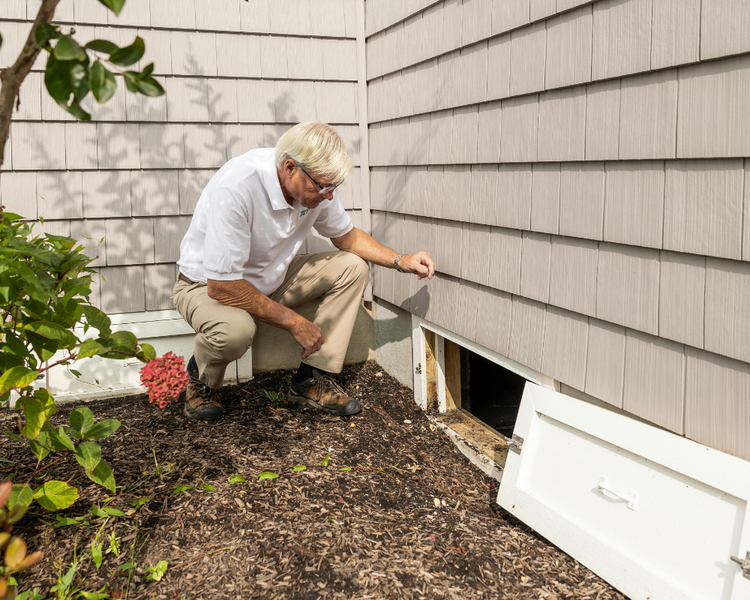
- Walk the full perimeter at ground level and mark every gap you can slide a pencil into. Utility penetrations (water line, electrical, propane) are the most commonly missed.
- Seal gaps with copper mesh or hardware cloth packed tight, then caulk or foam over it. Foam alone does not stop mice — they chew straight through it.
- Check the crawlspace hatch and any vents for torn screen, and cut back branches touching the roof or siding — deer mice and ants both use them.
- Pull firewood, lumber and brush piles at least 6 metres from the building and get them up off the ground. Firewood against a wall is a carpenter ant on-ramp.
Exterior — walls, soffits and roofline
- Inspect the south and west walls specifically for cluster fly entry: siding seams, window and door frames, where the soffit meets the wall.
- Screen or repair soffit and gable vents.
- Check the chimney cap and any exhaust vents for damaged flapper or screen.
- Fix the moisture sources: clear the gutters, re-seat downspouts so they discharge away from the foundation, and repair the leak above that damp corner post. Every carpenter ant problem starts with water.
Exterior — garage, shed and boathouse
- Replace worn garage door bottom seals and side weatherstripping. This is the single most common rodent entry we find at cottages.
- Empty and seal anything with food value — birdseed, pet food, grass seed — into metal or hard plastic containers. A paper bag of birdseed in a shed is a rodent feeding station.
Interior — kitchen and pantry
- Remove every food item. Not “seal it well” — remove it. Flour, rice, pasta, sugar, cereal, chocolate, and anything in a cardboard box goes home with you.
- Empty and defrost the fridge and prop the door open.
- Pull out the stove and fridge and check the wall behind for penetrations. The gap where the ice-maker water line enters is a classic.
- Wipe down everything. Grease residue and crumbs under a toe-kick will hold a mouse population all winter.
Interior — beds, closets and soft goods
- Strip beds. Bag bedding, towels and linens in sealed hard-sided bins, not garbage bags — mice chew plastic film easily.
- Stand mattresses on edge or cover them; leave closet and cupboard doors open so anything that does get in is visible in spring rather than nesting undisturbed.
- Take paper, cardboard and cloth home. Insulation, cardboard and paper towel are the three favourite nesting materials.
Interior — plumbing, drains and mechanical
- Once lines are drained, cover floor drains and open drain lines — an open drain is a route in for rodents and drain-breeding insects.
- Check under sinks for the plumbing penetration through the floor or wall: usually oversized, usually unsealed, always worth stuffing with copper mesh.
- Note any frass (coarse sawdust mixed with insect parts) below trim or on a window sill. That is carpenter ant excavation, and it needs a treatment, not a vacuum.
What a professional close-up visit actually does
An exclusion-and-treat visit is not a technician walking around with a sprayer. Done properly it is a full exterior inspection with the gaps documented in writing; physical exclusion in materials rodents cannot chew; an exterior perimeter treatment timed so a late-August or September visit also lands in the cluster fly window; targeted interior work where evidence exists — carpenter ant treatment into the actual galleries rather than surface spray; and a written record of what was found and sealed, so the spring open-up has a baseline to check against.
The point is to leave the building sealed, not to leave bait behind and hope.
What it costs
Straight numbers, from our published pricing:
- Mice, single visit — $345. One treatment for an active rodent problem.
- Complete Mice Protection — $495. The exclusion-focused option, which is the one that makes sense for a cottage you are leaving empty.
- General insect treatment — $475. Covers the general insect pressure including cluster fly work on the exterior.
- Carpenter ant treatment — $525. Targeted treatment for an active colony.
If you would rather not think about it each year, our annual plans run $845, $1,195 and $1,395 (VIP), with a $99 one-time initiation on annual plans. For a cottage that sits empty most of the year, a plan covering a fall close-up and a spring open-up inspection is usually the better structure — you get the two visits that actually matter, on the calendar, without having to remember to book them. Details on our residential pest control page.
Get the timing right
Late August to mid-September is the window. Early enough that cluster flies have not yet moved into the walls and mice have not yet been pushed indoors by the first cold nights, late enough that a seal-up will still be intact when you close for good in October.
Book it while you are still coming up on weekends. The worst version of this is deciding in mid-October to make one more trip north, in the cold, to do a job that needed a warm day.
Frequently asked questions
When should I book a cottage close-up pest visit? Late August through mid-September for most of Muskoka, Orillia and Simcoe County. That timing catches the cluster fly entry window and gets exclusion done before the first cold snap moves rodents indoors.
Do mouse traps left out over the winter work? Not really. A handful of snap traps might catch the first few mice, then they sit sprung and full for seven months while the rest of the population breeds. Sealing the building is what works; traps are a supplement, not a plan.
Why do I only see cluster flies in the spring if they get in during the fall? They enter in late August and September and go dormant in wall voids and attics. When spring sun warms those cavities, they become active and head for the light — which is why they turn up on windowsills the weekend you open up.
Can carpenter ants really do damage over one winter? A mature colony in damp framing keeps excavating through winter, especially in walls near a chimney or any residual warmth. Because nobody is there to notice, cottage damage tends to be found years after it started rather than months.
Do you service cottages in Muskoka and along Lake Simcoe? Yes — Muskoka, Orillia, Innisfil, Barrie and the surrounding 705 and Simcoe County area. Call (705) 302-1887 or take the free quote quiz to get a price without a phone call.
Need a Pest Control Expert?
Free quotes. Same-day available. Guaranteed results.