
Spider Season in Ontario: Why Late August Fills Your House With Webs
Quick answer: Ontario doesn’t get more spiders in late August — it gets bigger, more visible ones. The spiders hatched in spring reach adult size in late summer, males start wandering to find mates, and a peak insect population gives web-builders enough prey to hold large webs in the open. That’s why the front porch that was clear in June has three orb webs on it by Labour Day, and why house spiders start turning up in basements and garages as nights cool. Almost every spider you’ll see in the GTA, York Region and Simcoe County is harmless. The fix is not squishing — it’s removing webs consistently and treating the perimeter and the insect food supply that draws them. Sani IQ covers spider work across the GTA, York, Durham, Simcoe and Muskoka: (705) 302-1887.
Somewhere in the third week of August, the phone calls change. Through July it’s wasps. Then, almost overnight, it’s spiders — a web across the front door every morning, something the size of a toonie sitting in the middle of it, and a fist-sized wolf spider that came out from behind the recycling bin.
Nothing invaded. This is the annual, entirely predictable arc of the Ontario spider year reaching its visible peak — and understanding why it happens tells you what actually works against it.
Three things converge in late August
Spiders that hatched in spring are now adults. Most Ontario spider species overwinter as eggs or juveniles, hatch or emerge in spring, and spend the whole summer growing through successive moults. In June they were the size of a grain of rice and you walked past them. By late August the same individuals are at or near full adult size. The population hasn’t grown — the individuals have. That alone explains most of what people describe as a sudden spider problem.
It’s mating season, so males are wandering. Late summer into early fall is when most of our common species mate. Female web-builders stay put on the web; males abandon their own webs and travel to find them. A wandering male has no interest in your kitchen — he’s crossing it. That’s why the large spiders people encounter indoors in late August and September are so often out in the open on a wall or floor rather than in a web, and why they seem to appear from nowhere.
Prey is at its annual maximum. Flies, midges, moths, mosquitoes and gnats are at peak abundance right now. Web-building is expensive — a spider only maintains a large web where there’s enough traffic to pay for it. Peak insect numbers mean webs get bigger, get rebuilt nightly, and go up in exposed spots like door frames and porch lights that wouldn’t have been worth the effort in May.
That last point is the whole strategy in one sentence: spiders follow insects. Where your property produces or attracts insects, you will have spiders, and no amount of clearing webs changes that on its own.
What you’re actually looking at
Ontario has no spider whose bite is a medical emergency for a healthy adult. The black widow is present in a handful of very restricted southern Ontario locations — sandy Lake Erie shoreline habitat — and is essentially never encountered in a GTA or York Region home. The brown recluse does not live in Ontario; the ones that turn up are misidentifications, almost always of a harmless cellar spider or a wolf spider. Full identification details for each of the species below are on our spider identification pages.
Here’s what’s actually generating late-August calls:
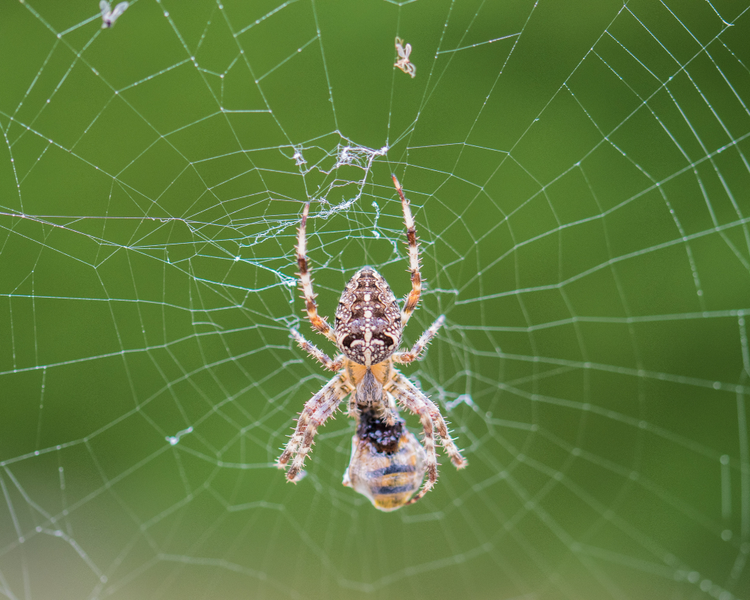
Orb-weavers — the big wheel-shaped web across the porch, the deck rail, or between the downspout and the shrub. Cross orb-weavers and the large yellow-and-black Argiope are the classic ones. They rebuild the web most nights, often eating the old silk. They’re the most visually dramatic spider most Ontario homeowners will ever see and among the least likely to bite; they’ll typically drop and hide long before you reach them.
House spiders — the messy tangle web in the corner of the garage ceiling, the basement window well, the shed. These build the cobweb-style webs and are the most common indoor spider in the province. They’re the reason webs come back within days of being cleared: the location is good, so another one takes it.
Cellar spiders — very long thin legs, small body, loose messy webs in basements, crawl spaces and under stairs. The real “daddy long-legs,” and the ones most often mistaken for a brown recluse. Harmless, and they prey on other spiders.
Wolf spiders — large, hairy, fast, and they build no web at all. They hunt on the ground and come indoors through gaps at grade — garage doors, basement window wells, unsealed sill plates. They’re the ones that startle people badly, especially in a garage or unfinished basement. They’re also the ones that most reliably signal a sealing problem rather than a spider problem.
Jumping spiders — small, compact, big forward-facing eyes, and they move in short deliberate hops. Usually seen on sunny window sills, siding and deck rails. Harmless, day-active and, for what it’s worth, the most likely to look back at you.
Dock spiders — very large, found near water. If you’re at a cottage on Lake Simcoe, Muskoka or Georgian Bay rather than in the city, this is the one that generates the phone call, and we’ve covered them separately in our dock spiders guide for Ontario cottage country.
Where the webs are tells you what to fix
Web location is diagnostic. Read it before you clear it.
Around exterior lights, door frames and window frames. This is the most common pattern and it’s a lighting problem, not a spider problem. White and blue-spectrum exterior lights pull in flying insects all night; the spiders simply set up where the food is delivered. Warm-toned or amber LED bulbs at entry doors, and moving a light off the door frame onto a nearby post, reduce both the insect traffic and the webs.
Under the deck, along the soffit line, in the corners of the porch ceiling. Sheltered, undisturbed, out of the wind — ideal for web-builders. These are the spots that need repeated mechanical removal, because they will always be attractive.
In garages, basements, crawl spaces and window wells. Points to ground-level entry gaps. Garage door weather seal is the single most common failure point, followed by unsealed utility penetrations and window well debris.
Suddenly heavy along one wall or one side of the house. Usually an insect source: a light left on, a bin or compost area, standing water, or dense vegetation touching the siding. Find the source and the webs thin out.
Inside, high in corners of otherwise clean rooms. Small flying insects are getting in — check screens, and check for a drain fly or fungus gnat issue somewhere in the house.
Why squishing and clearing webs never ends it
Clearing a web removes the display, not the cause. If the location is good — sheltered, near light, near insects — another spider occupies it within days. Homeowners often clear the same three spots weekly all September and conclude they have an infestation, when what they have is a good piece of spider real estate.
What actually reduces spider pressure, in order of effect:
- Cut the food supply. Change exterior bulbs to warm/amber, move lights away from doors, fix standing water, keep bins away from the wall, and cut back vegetation touching the siding.
- Remove webs consistently and mechanically. Every web removed is an energy loss the spider has to pay back; repeated removal makes a location genuinely unattractive rather than merely temporarily clear. Our spider web removal and prevention guide covers technique — poles, vacuuming, and where pressure washing helps and where it does damage.
- Seal at grade. Garage door seals, basement window wells, sill plate gaps, utility penetrations. This is what stops wolf spiders and ground hunters specifically.
- Treat the perimeter. A properly applied exterior perimeter treatment targets the band where spiders travel and harbour — foundation, eaves, soffits, window and door frames — and it suppresses the insect prey base at the same time. That combined effect is why perimeter work outperforms interior spraying by a wide margin for spiders. If you want the cost breakdown for professional spider work, we publish it in our Ontario spider control cost guide.
The order matters. Perimeter treatment on a house with a blue-white floodlight over the front door and a compost bin against the siding is fighting the homeowner.
What this looks like in the GTA and York Region
Housing stock changes the pattern. In Markham and Richmond Hill, the heavy late-August calls come from newer subdivisions with lots of exterior pot lighting, stone and stucco elevations with deep ledges, and mature landscaping close to the foundation — a lot of sheltered ledge plus a lot of light equals a lot of orb webs by September. In Vaughan and across the northern GTA, ravine-backing and greenbelt-adjacent lots get consistently heavier pressure than interior lots on the same street, because the insect base next door is far larger.
Ground-level entry is the other regional constant: attached garages with worn door seals are, in our experience, the number one route for the large hunting spiders that generate the most alarmed phone calls in this province.
If you’d rather find out what your property actually needs before booking anything, our free quote quiz takes about 30 seconds and sorts a genuine perimeter problem from a lighting fix you can do yourself this weekend.
Frequently asked questions
Are there dangerous spiders in Ontario? For practical purposes, no. The black widow exists in a few isolated southern Ontario shoreline habitats and is not an urban or suburban household concern; the brown recluse does not live here. Bites from our common species are rare and, when they happen, comparable to a minor sting. Anyone with an unusual reaction to any bite should see a physician.
Why are the spiders so much bigger right now? They’re the same individuals that hatched in spring, now fully grown. Late August is simply when the annual growth curve tops out.
Does spider season end when it gets cold? Outdoor webs disappear with the first hard frosts, usually October into November depending on where you are in the province. Indoor spiders in heated basements and garages persist year-round at low numbers, which is why a seal-and-perimeter approach holds better than a seasonal spray.
Do the ultrasonic plug-in repellers work? There’s no credible evidence that ultrasonic devices repel spiders or insects. Lighting changes, sealing and web removal all have measurable effect; the plug-ins don’t.
Should I kill spiders I find indoors? A spider indoors is eating other insects, and killing one has no effect on the population outside. Catch-and-release is fine. If you’re seeing several a week indoors, that’s an entry-point signal worth acting on rather than a body count to keep.
When’s the right time to book perimeter work for spiders? Late summer, before the peak, is the strongest timing — it suppresses the prey base while webs are being established rather than after they’re everywhere. Call (705) 302-1887 if you want it looked at this season.
Need a Pest Control Expert?
Free quotes. Same-day available. Guaranteed results.