
Cluster Flies in Ontario: Why They Swarm Sun-Facing Walls in Late August (and How to Shut Them Out)
Quick answer: Cluster flies gather on the south- and west-facing walls of Ontario homes from roughly mid-August through early October, warming themselves on sun-heated siding before squeezing into attics, wall voids and window frames to overwinter. They don’t breed indoors, bite, or spread disease — but one house can take in thousands. The fix is exclusion done before they arrive: seal soffit gaps, window trim, siding seams and attic vents by late August. Once they’re inside the walls, spraying accomplishes very little. Sani IQ handles fall exclusion across Simcoe County, York Region and cottage country — call (705) 302-1887.
The window is open right now, and it closes fast
Most pest problems announce themselves. Cluster flies don’t. They give you two or three quiet weeks in late August while they’re still outdoors, and then one warm afternoon in September you walk into a bedroom and there are forty flies on the window glass, moving slowly, bumping into each other. By that point the useful work is already behind you.
Homeowners in Barrie, Innisfil, Orillia and Newmarket consistently miss this window — not through carelessness, but because the pest gives no early warning. The flies you see in October got into the wall in late August. Whatever gap they used is still there, and the same house tends to get them year after year, because what attracts them is the building itself.
If you’re reading this in early August, you’re early. That’s the whole point.
What a cluster fly actually is
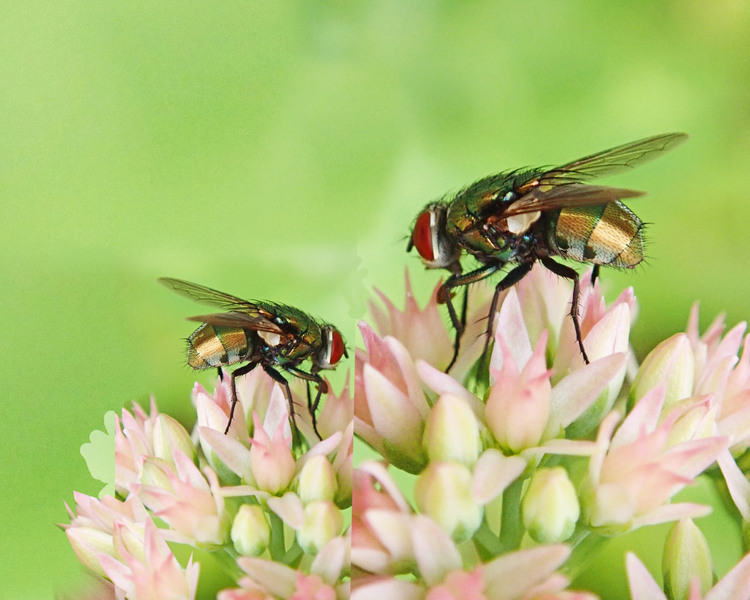
A cluster fly (Pollenia species) looks like a house fly at a glance — a bit larger, darker, with a slightly duller finish and short golden hairs on the thorax that you can see if you look closely. The behaviour is the real giveaway. House flies are quick and erratic. Cluster flies are slow, clumsy, and sluggish, especially in cool weather. They bumble. They land on you and don’t immediately leave.
Here’s the part that matters for how you treat them: cluster flies are parasites of earthworms. The larvae develop underground in soil, inside earthworm hosts. That means:
- They are not breeding in your garbage, your drain, or a dead animal in the wall.
- Finding them indoors doesn’t mean you have a sanitation problem.
- Killing the ones inside does nothing about next year’s population, which is out in the lawn and the field.
They also don’t bite, don’t carry disease the way filth flies do, and don’t damage the structure. What they do is arrive in overwhelming numbers, leave dark spots on sills and curtains, and make a clean house feel unclean. For rentals, short-term rentals and cottages, that perception problem is the actual cost. Full species-level ID detail is in our pest library.
Why they always pick the same wall
Cluster flies are looking for one thing in late summer: a warm vertical surface with a crack in it.
In the afternoon, the south- and west-facing walls of your house are the warmest large objects in the landscape. Light-coloured siding, brick, and stucco hold that heat into the evening, well after the air has cooled. The flies land there in the sun, warm up, and then start probing every seam within reach — because the instinct that’s driving them isn’t “get into that house,” it’s “get into a tight, dark, sheltered crack before it gets cold.”
Your soffit vent is a crack. So is the gap where the window trim meets the siding, the seam at the corner boards, the space around a dryer vent, the utility penetration where the AC line enters, and the ridge vent at the peak.
This explains three things homeowners always ask about:
- Why the same house every year. Nothing about the building changed, so nothing about the outcome changes. Neighbours with tighter envelopes get a fraction of the problem.
- Why one room is always worse. The room on the sunny corner, or the bedroom under the attic, sits closest to where they entered.
- Why rural and cottage properties get hammered. Cluster fly larvae need earthworms, and earthworms need undisturbed soil with organic matter. A house surrounded by lawn, pasture or mixed bush sits on a far bigger fly nursery than one on a small suburban lot — which is why Simcoe County, Muskoka and the Lake Simcoe/Couchiching properties see numbers that shock people who moved up from the city.
Signs you have them before you have them
Late August, on a sunny afternoon between about 2 and 6 p.m., walk the south and west sides of your house and look at the wall itself. Dozens of slow flies sunning on the siding — especially in the upper third of the wall, around soffit vents, gable vents and window frames — means your house is on their list this year, and you have days, not months.
The signs people usually notice first are already the “too late for the easy fix” signs: sluggish flies on interior window glass on warm winter days, dark specks on sills and light fixtures, a low buzzing in an upstairs wall, and dead flies in light covers.
Seal before. Don’t spray after.
This is the single most important sentence in this article: exterior exclusion applied before they land is worth more than any treatment applied after they’re in the wall.
Once cluster flies are inside a wall void or attic, they’re in a space you can’t reach, they’re dispersed through insulation, and they’re dormant. Insecticide applied indoors doesn’t reach them in any meaningful concentration, and the ones it does reach die in the cavity, where they attract carpet beetles and larder beetles — which is how a nuisance fly problem turns into a second, worse pest problem in the same wall.
The professional approach runs in the reverse order to what most people try:
- Exterior exclusion first — physically close the entry points before the flies commit to the building.
- Timed exterior treatment second — a residual application to sun-facing walls and entry zones, applied in the window before peak landing. Timing is the whole game: too early and it degrades before they arrive, too late and it’s decoration.
- Interior management third, and only mechanically — a vacuum. That’s it.
The exclusion checklist: where they actually get in
Work the sunny walls first, then the rest. Cluster flies fit through gaps around 3 mm — narrower than a mouse needs, wider than most people assume is “sealed.”
- Soffit and roofline — gaps where soffit panels meet fascia, unscreened or damaged soffit vents, gable vents with torn screen, the ridge vent seam. The number one route on two-storey homes.
- Windows — the gap where exterior trim meets siding, failed caulk at the sill, old wood sashes, screens that don’t seat.
- Siding seams — corner boards, J-channel ends, siding-to-brick transitions, anywhere siding has pulled away.
- Penetrations — dryer vents with stuck dampers, bathroom fan exhausts, AC line sets, cable and electrical entries, outdoor tap escutcheons.
- Attic access from outside — any louvre, cupola or unscreened vent.
Use exterior-grade caulk on trim seams, fine mesh (not standard window screen) on vents, and expanding foam only where it’s protected from sun. Do this in the last two weeks of August and the difference next winter is not subtle.
What a fall exclusion visit covers
A fall exclusion visit isn’t a spray. It’s a walk of the building envelope: a technician identifies and seals the reachable entry points on the sun-facing elevations, screens vents, checks the soffit line, then applies a properly timed exterior residual to the walls and entry zones. On a property with real cluster fly history, it’s also the visit where we tell you which structural repairs — a failed soffit run, a rotted trim board — are doing more damage than any product can compensate for.
It slots into the same visit as fall mouse exclusion, since the entry points overlap heavily and the timing is identical. If you’re booking one, book both. See how exclusion fits into ongoing coverage on our residential pest control page.
If they’re already inside
Vacuum them. A shop vac gets flies off window glass, light fixtures and sills quickly, and — unlike swatting — doesn’t smear the greasy mark cluster flies leave or crush them into fabric. Empty the canister outside afterward.
Don’t fog the interior. Don’t hang pest strips in a bedroom. And don’t seal an attic entry point in October: at that stage you’re not keeping them out, you’re keeping them in, and they’ll follow warmth and light down into the living space instead of back outside.
Then plan for next August. The next real opportunity is eleven months away and it lasts about three weeks.
Cottage country: the version nobody warns you about
If you own a cottage around Orillia, on Lake Simcoe or anywhere in the 705, cluster flies are effectively guaranteed. A building that sits empty from Thanksgiving to May is a stable, undisturbed, unheated cavity — exactly what an overwintering fly wants. Owners open up in spring to find hundreds of dead flies across every south-facing sill.
Fold cluster fly exclusion into your close-up routine rather than making it its own trip: seal the sunny elevations and vents during the same visit where you’re checking mouse entry points, shutting off water and doing the fall walk-around. We cover cottage properties across Orillia, Innisfil and the surrounding lake communities.
Frequently asked questions
Are cluster flies dangerous? No. They don’t bite, transmit disease, or damage wood and wiring. The problems are volume, staining on windows and fabrics, and the secondary beetle infestations that feed on dead flies inside wall voids.
Why do I only see them on warm winter days? They’re dormant in the wall or attic. A mild spell or furnace heat warms the cavity, they wake, and they move toward light — onto your interior window glass. It’s the same population you took in during September, not a new invasion.
Will sealing the entry points trap them inside? Sealed in late August before they move in, no — you’ve simply closed the door. Sealed in October after they’re established, yes, and it pushes them into the living space. Timing is the difference between a fix and a mistake.
Are they the same as house flies or fruit flies? No. House flies breed in waste and reproduce indoors; fruit flies breed in fermenting organic matter. Cluster flies develop underground inside earthworms and never reproduce inside your home. If flies are multiplying indoors year-round, it isn’t cluster flies and it needs a different diagnosis.
When exactly should I book a fall exclusion visit? Mid-August to early September in most of Ontario. In cottage country and higher-elevation properties, aim for the earlier end. If you’re already seeing flies sunning on the wall, book now rather than waiting for them to appear indoors.
What other pests are moving right now? Cluster flies aren’t alone in the late-summer push indoors. Our seasonal roundup of what’s active in Ontario right now tracks what’s peaking month to month.
Cluster flies are one of the few pest problems where the calendar matters more than the product. Seal the sunny walls in August and you’ll spend the winter not thinking about them. Serving Barrie, Orillia, Innisfil, Newmarket, York Region, Simcoe County and Muskoka — call (705) 302-1887.
Need a Pest Control Expert?
Free quotes. Same-day available. Guaranteed results.