
Why Are Ants Invading Your Home
This Spring?
You woke up this morning and there they were — a thin black line of ants marching across your kitchen counter. Sound familiar? You’re not alone. Ant calls are up significantly this spring across Ontario, and pest control professionals are fielding more questions than ever. Here are the three biggest ones — answered honestly.
1 Why Are Ants Suddenly Invading My Home This Spring?
The short answer: ants aren’t choosing your home at random — they’re responding to signals your home is broadcasting. Spring is the most critical season for ant colonies. After a long winter, queens ramp up egg-laying, worker populations explode, and foraging activity intensifies dramatically. The colony needs food, water, and warm nesting sites. Your home can provide all three.
Spring 2026 has added a twist making ant pressure worse than usual: an exceptionally dry season across much of Canada has dried out the soil ants rely on for moisture. When their natural water sources disappear underground, ant colonies don’t wait — they send workers scouting for alternatives. The trail ends, more often than not, at the nearest house.
The most common entry points into Ontario homes this time of year: the gap at the base of your door, hairline cracks in your foundation, utility pipe penetrations, and where your siding meets the ground. Ants are flat-bodied and persistent — a gap as small as 1/16 of an inch is plenty.
- 🐜
Scout trails in the kitchen — small, single-file lines leading toward food or countertops. These are forager workers reporting back to the nest.
- 💧
Ants near moisture — around the sink, under the dishwasher, along humid basement walls. Ants need water as much as food, especially in a dry spring.
- 🪵
Sawdust-like debris near wood — this is called frass, and it signals something more serious than a sugar ant problem.
- 🚪
Ants appearing from walls or baseboards — this usually means a satellite colony has already been established inside your home.
The bottom line: ant invasions in spring are driven by biology, not bad luck. If you’re seeing ants now, the colony has likely been scouting your home for weeks. Waiting to act only gives the colony more time to expand.
2 How Do I Know If I Have Carpenter Ants — and Why Does It Matter?
Not all ants are created equal. Most of the tiny ants marching toward your sugar bowl are odorous house ants or pavement ants — annoying, but structurally harmless. Carpenter ants are a completely different story. They are the ant species Ontario homeowners genuinely need to worry about, and spring is the season they become most active and visible.
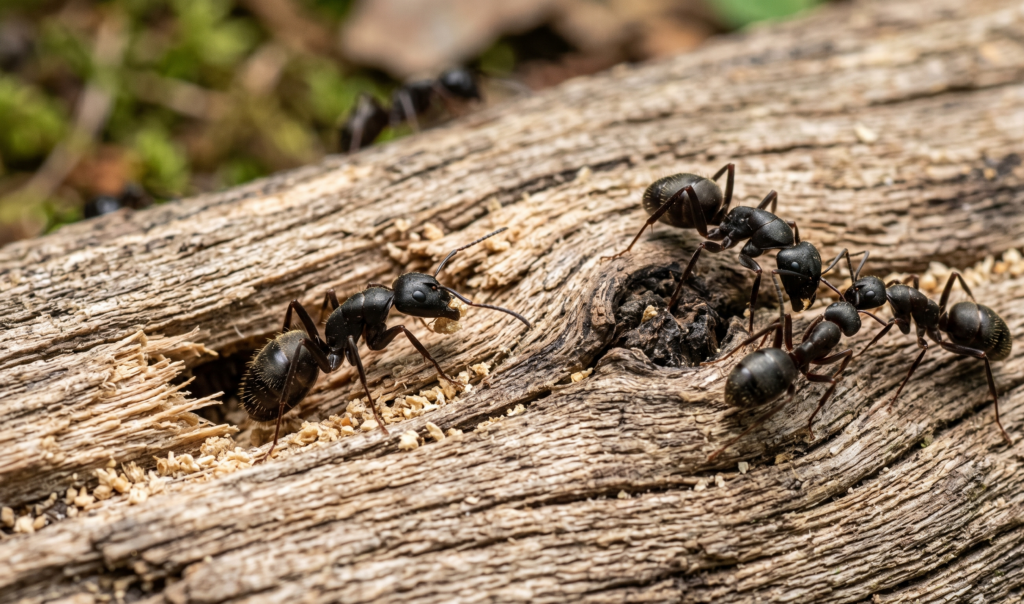
Carpenter ants are the largest ants you’ll find in Canada — typically 6 to 13 mm long, usually jet black, though some species have reddish or dark-brown segments. They don’t eat wood, but they excavate it with surgical precision to build their nests, carving smooth, clean galleries inside structural beams, window frames, door frames, and wall voids. Left untreated, a mature carpenter ant colony can cause structural damage rivalling that of termites.
| Ant Type | Size | Color | Where Found | Damage Risk |
|---|---|---|---|---|
| 🖤 Carpenter Ant | 6–13 mm | Black / dark red | Near wood, walls, windows | HIGH ⚠️ |
| 🟤 Odorous House Ant | 2–3 mm | Dark brown/black | Kitchen, pantry, food | Low ✓ |
| ⚫ Pavement Ant | 2.5–4 mm | Dark brown to black | Driveways, foundation cracks | Low ✓ |
| 🟡 Pharaoh Ant | 1.5–2 mm | Pale yellow/orange | Warm indoor areas | Low ✓ |
Carpenter ants are attracted to moisture-damaged wood — leaky pipes, aging window frames, poorly ventilated attics. In spring, as ice melts and moisture permeates walls and soffits, carpenter ants have a field day finding new nesting sites.
→
One important detail: carpenter ants maintain a parent colony (usually outdoors in a tree stump or dead wood) and satellite colonies indoors. Treating only what you see inside rarely works — the parent colony sends reinforcements. This is exactly why over-the-counter sprays feel like playing whack-a-mole with a black ant problem that never seems to end.
3 What Actually Works to Get Rid of Ants — DIY or Professional Treatment?
The honest answer: it depends on what you’re dealing with. Here’s how to think about it.
🔧 DIY Methods
- Effective for small, early-stage odorous or pavement ant problems
- Bait stations (not sprays) are the most effective consumer option — they let workers carry poison back to the nest
- Caulking entry points and removing food sources helps prevent re-entry
- Borax-based baits can work over 1–2 weeks with consistent application
- Sprays only kill visible ants — they scatter the colony and rarely reach the queen
🛡️ Professional Treatment
- Identifies the specific species — critical for targeting the right nest
- Applies residual treatments inside wall voids, around the foundation, and at entry points
- Directly targets parent and satellite colonies, not just foragers
- For carpenter ants: non-repellent products workers unknowingly carry back to the nest
- Includes a barrier treatment to prevent re-infestation for months
The rule of thumb most pest professionals use: if you’ve been seeing ants for more than two weeks, if DIY treatments haven’t worked after a second application, or if you have any reason to suspect carpenter ants — it’s time to bring in a professional. The cost of professional treatment is almost always less than repairing structural damage from a colony left to grow unchecked.
The best time to act is now — before the colony reaches peak size in June and July. Early-season treatments are faster, less expensive, and dramatically more effective than treating a mature late-summer infestation. Ontario homeowners who invest in a professional barrier treatment in May typically see far less ant activity through the entire season.
→
Ready to Protect Your Home This Ant Season?
SaniIQ’s certified technicians identify your ant species, locate the nest, and apply targeted treatments that actually eliminate the colony — not just the visible trail.
Book a Free Inspection →
100% satisfaction guarantee · Serving Ontario homeowners since 2018